

(Quick…before everyone else finds it)
There is a side of Portugal which many of us don’t know. Yet.
Lisbon gets the city-break crowds, Porto gets the wine lovers and the Algarve gets everyone armed with SPF30 and a Ryanair boarding pass.
But tucked away in central Portugal is a place that somehow still feels like a genuine discovery: Tomar. And honestly, it almost feels like a crime to tell more people about it, for fear of it being discovered by mass tourism.
The town itself is relatively small, so don’t come here looking for another Porto or Lisbon. You’ll be disappointed. But if you crave slow living and love architecture, cafés, history, affordable prices and the smug satisfaction of saying “we visited this amazing place before everyone else did,” Tomar and the surrounding area should absolutely be on your radar.
Unlike picture postcard perfect Sintra (below), which was heaving when we visited in April, Tomar is rather more laid back and empty, by comparison. It still has a castle – a 12th-century hilltop one built by the Knights Templar in 1160 – but feels a million miles away from mass tourism – or did when we visited in the spring of 2026.
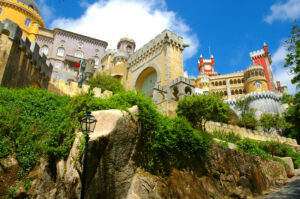
Sintra is well worth visiting, even if you don’t into the castle itself, but rather glimpse it from the road and stock up on some pastéis de nata and other amazing sweet treats at Casa Piriquita, which has had people queuing out the door since 1862.
But because the Tomar area is still relatively under-the-radar compared with Portugal’s bigger tourist hotspots, you can often explore the area without massive crowds — which makes the atmosphere even better.
If you’re searching for:
- Hidden gems in Portugal
- Underrated Portuguese towns
- Alternative places to visit in Portugal
- Day trips from Lisbon
- Authentic Portugal travel experiences
…Tomar and the surrounding area should be very high on your list.
Where is Tomar in Portugal?
Tomar is located in central Portugal, around 90 minutes north-east of Lisbon by train or car, making it ideal for either a weekend break or a slower stop on a Portugal road trip itinerary.
The countryside around Tomar is a peaceful, rolling landscape of eucalyptus forests, olive groves and vineyards. It is dotted with small, agricultural villages, traditional quintas (country estates) and medieval ruins, all tied together by a relaxed, rural pace of life
Despite being home to one of Portugal’s most important UNESCO World Heritage Sites, Tomar itself receives a fraction of the visitors seen in Portugal’s bigger tourist destinations. While it’s not so off the beaten track that you’ll be the only one there in high season, you can still wander through historic streets of the town – wondering which restoration project your budget can afford – without fighting your way through selfie sticks and tuk tuks.
The Knights Templar history
Tomar is best known as the historic headquarters of the warrior monks the Knights Templar in Portugal. They were a powerful medieval Christian military order founded around 1119, shortly after the First Crusade. Their full name was the Poor Fellow-Soldiers of Christ and of the Temple of Solomon.
They were originally created to protect Christian pilgrims travelling to Jerusalem, but over time they became incredibly wealthy and influential across Europe. They were known for:
- Their distinctive white cloaks with red crosses
- Building castles and fortifications across Europe and the Middle East
- Developing an early banking system for pilgrims and nobles
- Becoming enormously rich and politically powerful
It was that last bit eventually caused problems. By the early 1300s, King Philip IV of France owed the Templars huge amounts of money and became increasingly suspicious (and probably jealous) of their power. In 1307, many Templars were arrested, accused of heresy and tortured into confessions. The order was dissolved by the Pope a few years later.
Portugal, however, treated the Templars differently.
Instead of destroying them completely, the Portuguese king effectively rebranded them into a new order called the Order of Christ. That’s one reason why Tomar became so important: it was the Templars’ Portuguese headquarters and later the centre of the Order of Christ.
The spectacular Castle of Tomar and Convent of Christ are among the best surviving examples of Templar architecture anywhere in the world. So, if you visit Tomar, you’re not just visiting a cute Portuguese town — you’re walking through a huge piece of genuine medieval history.
What is there to see in Tomar?
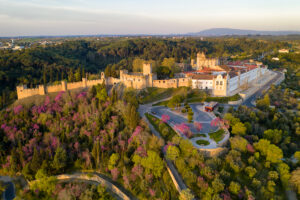
Dominating the town is the extraordinary Convent of Christ, a vast UNESCO-listed monastery and castle complex dating back to the 12th century.
Originally built as a Templar stronghold, the complex evolved over centuries into one of the most architecturally impressive sites in Portugal. Gothic cloisters, Manueline stone carvings, hidden passageways, grand halls and peaceful courtyards somehow all coexist in one enormous maze-like building.
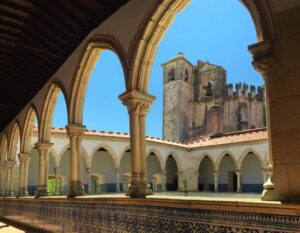
Highlights include:
- Massive medieval defensive walls
- Panoramic views over Tomar
- The Charola (a round Templar church inspired by Jerusalem’s Church of the Holy Sepulchre)
- Secretive Knights Templar history
- Beautiful cloisters and Manueline architecture added later
It genuinely looks like somewhere that should feature in a fantasy film franchise.
Why are there so many abandoned buildings in Tomar?
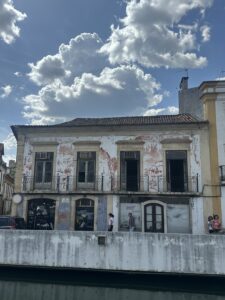
One thing you’ll notice in Tomar – and across parts of inland Portugal generally – is the high number of semi-derelict buildings, some of which can be bought for what may feel like peanuts.
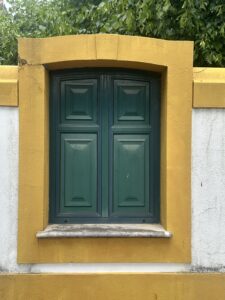
At first glance, it can feel surprising. You’ll see elegant tiled townhouses sitting next to faded, empty properties with crumbling shutters and wild plants growing through balconies.
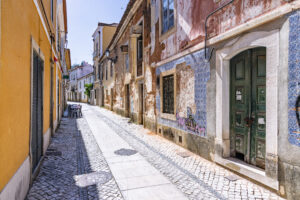
There are a few reasons behind this:
- Portugal’s younger population has historically moved toward bigger cities like Lisbon and Porto for work
- Inheritance laws can make renovating old family properties legally complicated
- Restoration costs are often extremely high
- Some inland towns saw decades of population decline before tourism began increasing again
But strangely, it adds to Tomar’s atmosphere rather than detracting from it. The town feels authentic and layered rather than polished for tourists. Increasingly, many abandoned buildings are now being restored into boutique hotels, apartments, cafés and creative spaces as more travellers discover the area.
It’s a town caught somewhere beautifully between past and future.
Tomar’s markets, cafés and local life
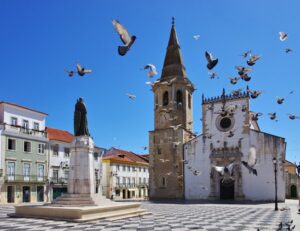
One of the best things about Tomar is that it still feels like a real Portuguese town rather than a tourism production line.
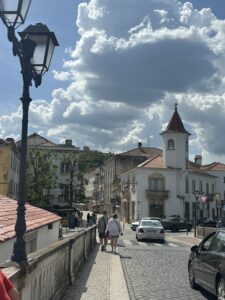
The central square, Praça da República, is lined with cafés and restaurants where locals outnumber visitors on many days. There are regular produce markets, antique stalls and local fairs throughout the year, particularly around weekends and festivals. And, embarrassingly for someone who can’t string together more than two words in Portuguese, almost everyone speaks impeccable English.
The town is especially known for:
- Traditional Portuguese food
- Local wines
- Olive oil
- Handmade crafts
- Relaxed outdoor dining
Unlike more heavily visited parts of Portugal, prices still feel refreshingly reasonable. We sat in the main square for a while and had Aperol spritz for €8 each.
Why are there so many tiled buildings in Tomar?
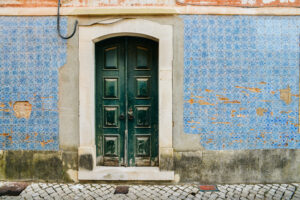
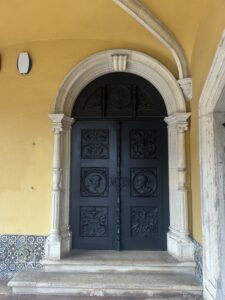
The beautiful tiled buildings in Tomar – and throughout Portugal – are part of one of the country’s most iconic architectural traditions: azulejos.
These decorative ceramic tiles became hugely popular across Portugal from the 16th century onwards, influenced partly by Moorish design traditions and later by Portuguese artistry and trade wealth. You will find them all over Portugal – not just Tomar.
But the tiles weren’t just decorative — they were practical too. In places like Tomar, tiled exteriors helped:
- Protect buildings from damp and heat
- Reflect sunlight during hot summers
- Insulate walls
- Preserve older stonework
- Make homes easier to clean
Over time, they also became a way for families and businesses to show status and personality. Different colours, patterns and designs often reflected particular time periods or artistic trends.
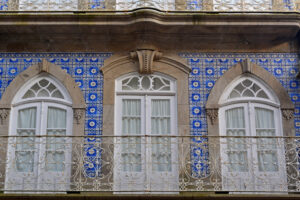
In Tomar specifically, the abundance of tiled buildings is linked to the town’s historical prosperity. As an important religious and trading centre connected to the Knights Templar and later the Order of Christ, Tomar benefited from wealth and influence for centuries. Many elegant townhouses were built or renovated during Portugal’s richer periods, particularly in the 18th and 19th centuries, when decorative tilework became especially fashionable.
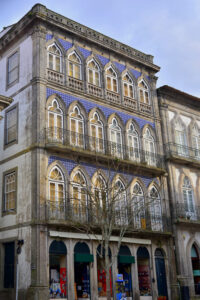
One of the reasons Tomar feels so visually striking today is because those layers of history are still visible everywhere:
- Faded pastel façades
- Blue-and-white azulejos
- Ornate balconies
- Weathered shutters
- Grand old townhouses sitting beside partially crumbling buildings
It gives the town that slightly romantic, timeworn atmosphere that feels far more authentic than somewhere overly polished for tourism.
Wandering around Tomar felt a little like walking through a Pinterest board curated by a slightly eccentric medieval art historian with a passion for tilework.
What is there to do near Tomar?
You can easily cover all of Tomar’s attractions in a day, but the surrounding countryside provides more to do – so make sure you hire a car.
River swimming in Tomar: one of Portugal’s most underrated summer experiences
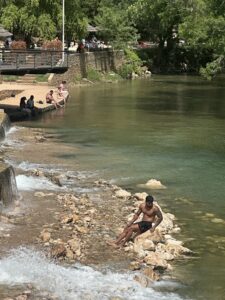
One of Tomar’s best surprises is how much nature surrounds the town.
The nearby river beaches, or ‘praias fluviais’, are hugely popular with locals during the summer and offer a completely different experience from Portugal’s crowded coastline beaches.
Clear freshwater swimming spots, shaded picnic areas and peaceful woodland scenery make them perfect for escaping the heat. However, enter with caution and adhere to signs. River currents can make swimming dangerous, so only swim where it says it is safe to do so.
That aside, if you’re visiting the Tomar region in the warmer months, adding a river beach day to your itinerary is absolutely worth it.
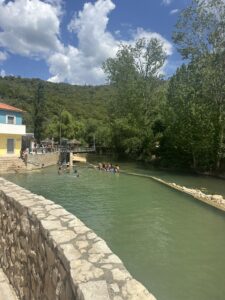
Around 20 minutes out of town isPraia Fluvial do Agroal (above) – probably the most popular of river beaches, known for its crystal-clear (and VERY cold) spring-fed water. We went in April and were the only British people there and the water was icy.
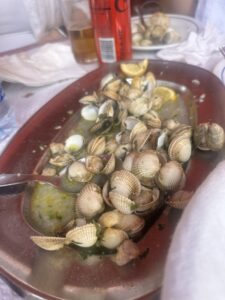
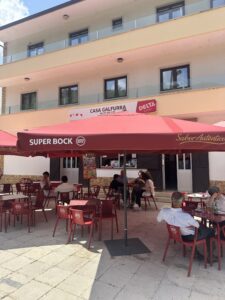
Parking will undoubtedly be tricky when the temperature rises, but there’s lots of shade, toilets and sun loungers. Make an afternoon of it and have a long, lazy lunch at one of the cafes. We had a hearty lunch of super sweet clams and a tasty pork stew, accompanied by local beer and big chunks of bread, at Casa Galfurra. There’s no website but it was very reasonably priced.
Some of the other river beaches near Tomar are:
- Praia Fluvial de Montes — on the Castelo de Bode reservoir and often considered one of the prettiest swimming spots near Tomar.
- Lago Azul (Blue Lake) — a popular swimming and watersports area on the Castelo de Bode reservoir near Ferreira do Zêzere.
- Praia Fluvial da Bairrada — quieter and more local-feeling, also on the Zêzere river.
- Praia Fluvial da Mendacha — a peaceful, lesser-known river beach surrounded by nature.
- Praia Fluvial de Aldeia do Mato — a beautiful reservoir swimming area with floating pools and watersports.
- Penedo Furado — slightly further away near Vila de Rei, but absolutely worth mentioning because it has waterfalls, wooden walkways and natural plunge pools.
The nearby viaduct that looks straight out of a film set
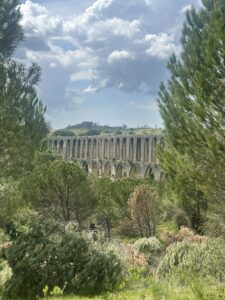
A short drive from Tomar is the spectacular 400-year-old, 6km long Aqueduto dos Pegões. While I can only marvel at an aqueduct for so long – a fault of mine, not the aqueduct’s – it is well worth jumping out of your hire car to take some photos, at the very least.
This dramatic 16th-century aqueduct was built to supply water to the Convent of Christ. Towering stone arches cut across the landscape in a way that feels oddly cinematic.
Where to eat in the Tomar area
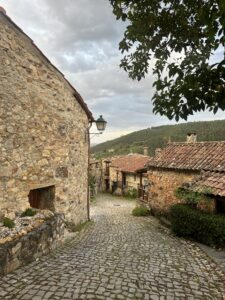
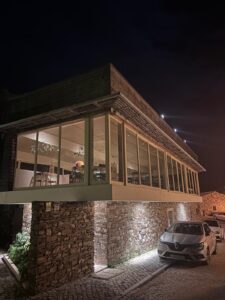
A 40-minute drive out of town for is the superb and contemporary Restaurante Varanda do Casal (above right) in the perfectly peaceful, stone and cobbled village of São Simão (above left), which we wandered around before eating.
We went there on Portugal’s Freedom Day (Dia da Liberdade) on April 25 – a national holiday commemorating the 1974 Carnation Revolution that ended decades of dictatorship – thinking the restaurant would be heaving, but were the only people there. Maybe it’s not the done thing to eat out on that day!
The menu is short and dishes are for sharing, using seasonal produce from local suppliers – and produce from Dona Isolina’s garden!

For starters there was unreal, fresh asparagus, cheese and venison croquettes (above). Some of us shared the oxtail pie (below) – a sublime, slightly runnier take on a British shepherd’s pie, for comparison purposes, which I could have eaten until I passed out. It was served with the simplest, but beautifully dressed salad of just leaves and white onions. The salad was a masterpiece in itself (oxtail pie: €48 for two people).

Another delicious dish was the five-hour Slow-Roasted goat in Port Wine with Corn Xerém – a very flavoursome a traditional, savoury cornmeal porridge (€46 for two people). I’d highly recommend visiting and I am sure you’ll be made to feel as welcome as we were by the young and knowledgeable, charming host.
Why Tomar is perfect for slow travel in Portugal
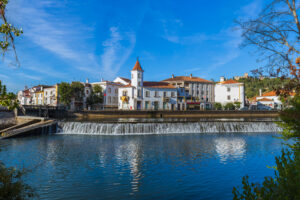
Tomar isn’t a city of frantic sightseeing checklists.
It’s somewhere to:
- Wander slowly
- Sit in sunny squares
- Eat long lunches
- Discover hidden streets
- Chat to the bar man
- Stumble across unexpected history
- Drink wine by the river
- Embrace a slower pace of travel
Which, frankly, many of us probably need as a contrast to covering 27,000 steps a day in Lisbon!
Final thoughts: is Tomar worth visiting?
Absolutely.
If you’re looking for an authentic Portuguese destination with history, beauty, affordability, nature and fewer crowds, Tomar might genuinely be one of the best hidden gems in Portugal right now.
It has UNESCO history, Knights Templar intrigue, river swimming, incredible architecture, local markets, fantastic food and a relaxed atmosphere that’s becoming increasingly rare in Europe’s better-known destinations.
The only downside? You may end up wanting to tell absolutely everyone about it – while simultaneously hoping nobody else finds out.

How to get to Tomar from the UK:
Direct flights to Lisbon operate year-round from major UK airports (London Heathrow, Gatwick, Stansted and Manchester) via airlines like TAP Air Portugal, British Airways and easyJet.
We stayed at a fried’s house nearby, but saw plenty of quality hotels in town. This one caught my eye as we walked past!
Want more Portugal travel tips?
Read tips on how to spend 48 hours in Lisbon here.
Follow a friend’s passion project to restore a Portuguese farmhouse here.
Spend a weekend in Porto and the Douro valley here.
For more honest travel content, follow The Sun Lounger on social media:


