
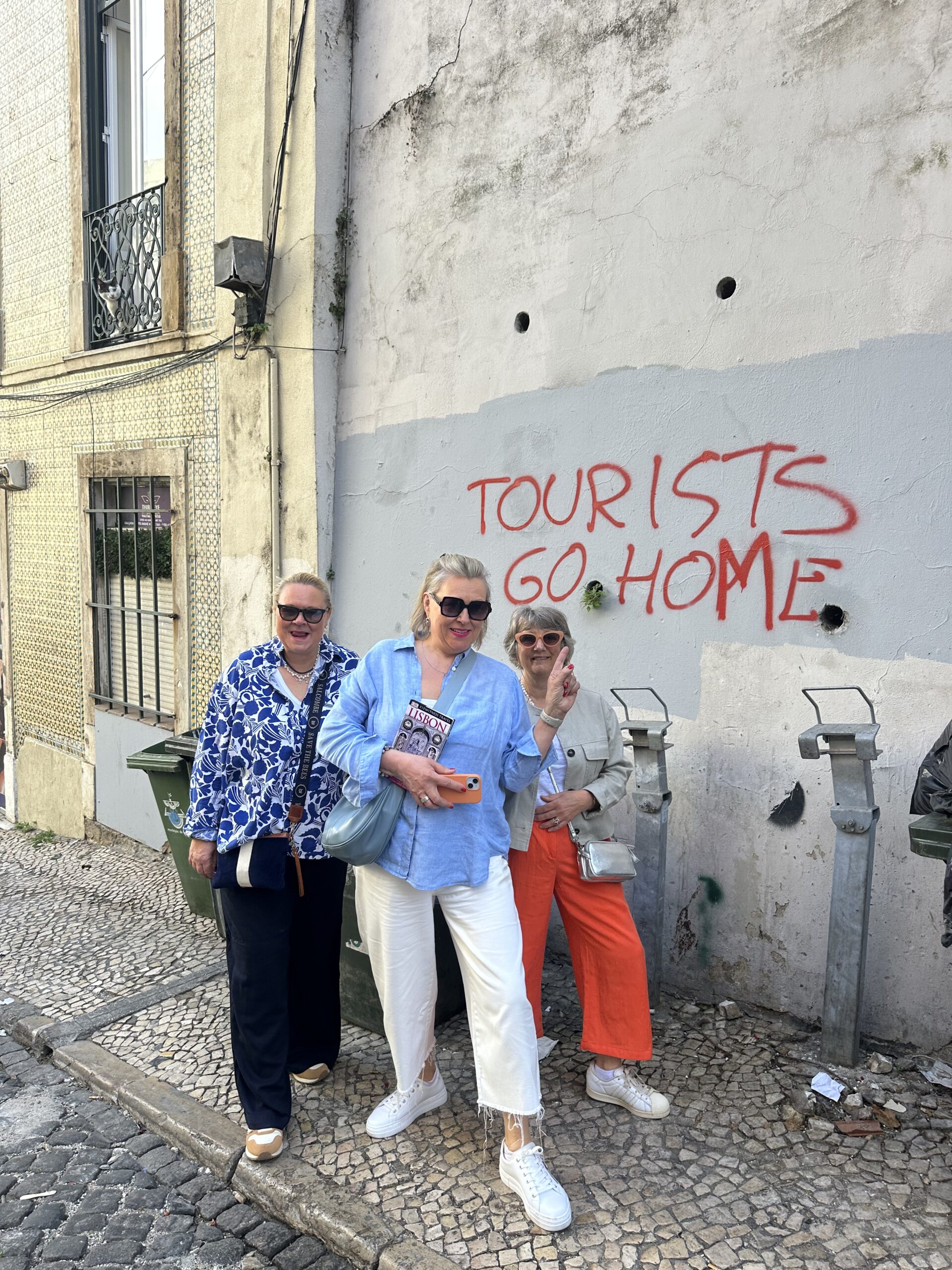
Seeing graffiti saying ‘Tourists Go Home’ on arriving in a city for a long weekend can be jarring.
You’ve arrived there to have a good time, soak up the views and the culture, but having an underlying worry that you’re not wanted there could potentially put a dampener on the weekend. However, it is important to remember that it’s not personal and it is part of a wider, global issue.
Lisbon is a beautiful city. The streets are filled with fragrant Jacaranda trees, which turn the city a vibrant purple and lilac. It’s decidedly hilly, known as the ‘City of Seven Hills’ and has what may sometimes feel like vertical, often slippery, cobblestone streets, which provide vantage points for great views over the river Tagus (known as Tejo in Portuguese). As the longest river on the Iberian Peninsula, it flows from Spain and forms a large estuary at Lisbon before discharging into the Atlantic Ocean.
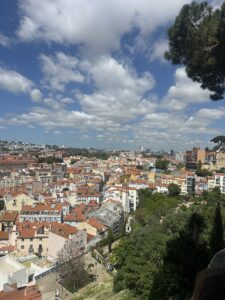
While the Baixa district is flat, neighbourhoods like Alfama and Bairro Alto are very steep. Good public transport, including trams, funiculars and lifts, helps navigate the elevation.
Visitors will also notice a fair few derelict or abandoned buildings – although Porto, I thought, seemed to have more. These are primarily caused by decades of rent freezes, complex inheritance laws and high renovation costs for historic buildings. With over 15% of housing stock vacant in some areas, many owners cannot afford repairs, are stuck in legal battles over ownership or are holding properties for investment, leaving thousands of properties empty. It’s no wonder, some might say, that they rent them out as holiday homes.
Is Lisbon welcoming to tourists?
We never felt unwelcome in Lisbon, at all. Visiting in April and chatting to local people, who told me that they were not fans of mass tourism in their city (which they call Lisboa, pronounced Lijj-boa) I came to understand how they felt.
They were from Bairro Alto – the liveliest district of all in the evenings – and talking to them made me wonder how I would feel if the streets I called home were teeming with often drunk, rowdy groups at night and many of the properties there were holiday lets. That said, most of the marauders we saw in Bairro Alto on the evening we visited were Portuguese!
Being a Brit, there are parts of London I avoid because I get easily annoyed by groups of tourists walking slowly, often four-breast, blocking the path and stopping to take photos, especially when I have somewhere to be. I live a stone’s throw away from Cambridge and that too gets annoyingly congested with tourists, particularly in the summer, making a shopping or business trip often deeply frustrating.
On one of my most recent trips to Barcelona, a city which I know very well, I felt that parts had turned into what felt like a Catalan theme park, with the streets feeling debauched and libertine at night. Some locals there have being decidedly hostile to tourists, as a result.
Is tourism damaging to Lisbon?
Many residents in Lisbon have been dealing with rising rents and housing shortages – partly linked to short-term rentals, overcrowding in historic neighbourhoods like Alfama and Bairro Alto and the loss of local shops and community feel.
In my view, graffiti like the example I saw (and I only saw it once) is directed at mass tourism and policy issues, not individual, respectful visitors. Certainly, talking to those whose income relies on tourism, you will hear a different story. They don’t want the tourism to slow down.
Tourism is highly valuable to Lisbon, functioning as a major economic driver that generated over €1.5 billion in revenue in 2024. It has boosted employment, improved fiscal positions and financed infrastructure. However, this boom is a double-edged sword, causing high rental density (70% in some areas), housing shortages and gentrification.
How to be a good tourist in Lisbon
The graffiti we saw was more of a protest banner, rather than a personal message, I believe. Therefore, I didn’t take it to heart. It’s part of a bigger issue.
Be a low-impact visitor. For example, keep noise down in residential streets at night, don’t block narrow pavements for photos and respect queues, local customs and personal space.
You can support the local economy thoughtfully by eating at family-run restaurants instead of chains, shopping at local businesses and avoid contributing to overcrowding when possible.
Look for small, local eateries, Portuguese menus and places filled with locals. These are often even better if the restaurant looks slightly chaotic. Avoid places with photos of the food and treat places where people are waving you in as red flags.
Stay in the right places if you can. Hotels or licensed accommodations are often less controversial than short-term rentals in residential buildings. Note to self: this is something I need to do more of.
While we found that local people speak brilliant English, it’s always wrong to assume they do and I imagine it can be rather annoying for them. A simple “Olá” (hello) or “Obrigado/a” (thank you) can go a long way.
If you remember one thing, behave like you’re staying in someone’s actual neighbourhood, because you are.
How to spend a weekend in Lisbon:
We had two nights in proudly-beautiful Lisbon as we were meeting a friend and heading to his house in the countryside for another 48 hours (another blogpost coming soon). Here is what we did:
Day one:
We flew Luton to Lisbon with Easyjet (flights, with hold luggage and reserved seats were £165 per person). Flights take around three hours and we arrived in Lisbon at 3.20pm. It’s an odd airport as arriving tourists walk through departure lounges and mix with those waiting to board. We were expecting lengthy queues, due to new biometric identification having just been introduced, but we saw none.
There is no time difference between the UK and Lisbon as both are on the same longitude.
There were four of us travelling and I arranged airport transfers via Booking.com, as we are ladies who do not travel lightly! The transfer cost around £50 and our driver was waiting in the arrivals hall when we landed. Transfer to our accommodation in the Alfama district, took around half an hour.
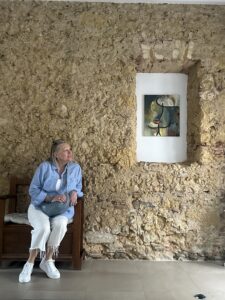
A friend had booked Airbnb accommodation in what looked, from the outside, like a slightly dilapidated building, in a narrow alleyway. It turned out to be a high quality, Tardis of a property on the inside, with four bedrooms, sleeping a total of nine, exposed stone walls, art on the walls and multiple terraces, set over three floors. One bedroom (on the ground floor) didn’t have windows. Two nights for four people cost £933.
On arrival, we were starving and happened by accident upon a lovely little café/bar called Focaccia in Giro in Campo de Santa Clara – right near our accommodation, which served the best avocado toast I have ever tasted. This became our local for the stay and we enjoyed the avocado toast – and several other dishes – several times.

Our server, Gustavo, was a charming, very friendly (and handsome) young man who made us feel completely welcome every visit! It wasn’t obviously an Italian restaurant, otherwise we probably wouldn’t have gone there.
Following that, we went on walkabout to get our bearings and buy essentials for the apartment, such as water, fruit and, of course, Aperol!
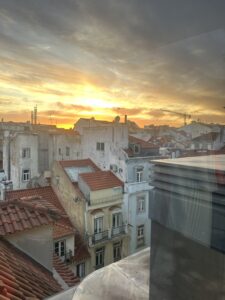
Our destination for our first evening was Lumi rooftop bar, which was an Uber drive away from our apartment, despite ChatGPT having told me it was a short walk. We are glad we didn’t listen to AI. Booking at Lumi is essential and it is situated on the fifth floor of the Lumiares Hotel in Bairro Alto.
This is an elegant, quite compact space with views over the terracotta rooftops and out across the river. We arrived just after 8pm – in time for sunset – and enjoyed Portuguese wine and tapas-style snacks.
When you book Lumi online, you have to leave a security deposit, in case you don’t show. As with all restaurants in Lisbon, I recommend you book in advance.
On the menu (and recommended) were: oxtail croquettes with roasted carrot, mustard and pimentón de La Vera (€13); a Portuguese cheese and charcuterie platter (€25); chicken skewers in pitta bread with spicy yoghurt sauce (€18.50) and spicy king prawns sautéed in garlic and herbs (€21.50).
Day two:
We’d consulted ChatGPT, asked a friend of a friend who lives in Lisbon and another friend who has a house in the countryside about 90 minutes away, and had decided to spend our only full day in Lisbon wandering and enjoying the sights, taking in various recommendations.
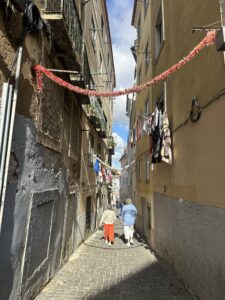
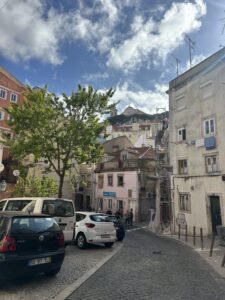
Alfama, where we stayed, is Lisbon’s oldest and most picturesque neighbourhood, characterised by a steep, maze-like labyrinth of narrow streets, traditional tiled houses and an historic, vibrant atmosphere. Key highlights include the Castelo de São Jorge, Sé de Lisboa cathedral, stunning viewpoints like Miradouro de Santa Luzia and authentic Fado music venues.
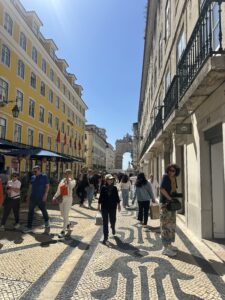
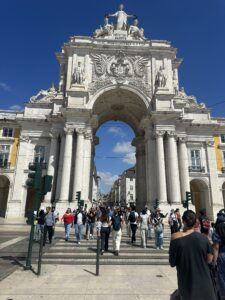
We went on walkabout, taking in the stunning views and eventually finding ourselves in Rua Augusta – the main shopping street, at one end of which is a triumphant arch – for a light brunch.
I had poo-pooed the idea of a tuk-tuk tour around the city because I, quite frankly, look down my nose at them. However, when we happened upon the shiny blue , electric, faux vintage vehicle which belonged to a very lovely and highly knowledgeable young lady called Jacinta, I U-turned on my opinion. And I am so glad I did.

There is very little Jacinta doesn’t know about Lisbon and she took us on a two-hour tour of the city (€150), taking in all the best viewpoints and tourist attractions. I continued to look down my nose at the hoards of tuk-tuks, some of which were operated by people with no knowledge of the city, we learned, so they simply played banging music instead. Jacinta loitered at all of the best spots inviting us to get out and see the best views.
It is easy to imagine how the streets get utterly clogged with tuk-tuks in high season and how annoying the noisy ones must be.
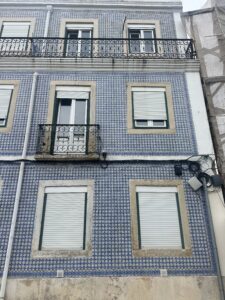
Lisbon’s buildings are famously painted in vibrant pastel shades (yellow, pink, blue, ochre). Jactina explained that this harks back to when many of the city’s occupants couldn’t read, hence different buildings were different colours, to indicate what was within. I forget now which was which!
The city’s unique colour palette is also defined by azulejos (ornate ceramic tiles), which were introduced by the Moors, and which provide weather protection and add artistic, cultural expression to facades.

I’m not sure if Lisbon Vintage Tours is the company Jacinta works for (her vehicle said ‘Vintage Tours’ on the door), but the above link should give you an idea of what the vehicles look like.
We were meeting a friend for lunch in an elevated spot in the less touristy part of the city and Jacinta took us there and we gave her hugs and kisses when she departed – off to impart her excellent knowledge on another group of grateful tourists.
It’s great to have a friend in the know, otherwise we would never have happened upon Linha de Água terrace, which is located in Jardim Amália Rodrigues. This space makes you forget that you are in the heart of Lisbon.
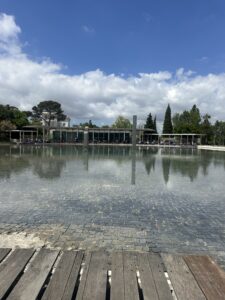
At meal times, there’s a selection of salads and cold quiches, plus other tasty treats. Outside meal times, the terrace operates as a cafeteria-pastry shop. It’s a stunning modern building, reached via a walkway over water and lily pads, with sun loungers pointing towards the city.
When there, you have to order and pay via an online menu, which is a little annoying to navigate, but we managed and enjoyed a steady stream of decent quality snacks, which included fresh mozzarella, tomato and basil pesto grilled sandwich (€7.50); shrimp rissole (€2.50); meat croquette (€2.50); spinach quiche (€5) and, of course, Aperol spritz (€8.50 each).
After lunch, three of our party went to an exhibition of art and fashion at The Gulbenkian Museum, while two found a local bar and drank wine (six glasses for €9, which can’t be sniffed at). I won’t be giving any prizes for guessing what I did!
Pretty soon it was time to go out to dinner again and we had pre-booked a table in the courtyard at Bairro do Avillez – a pretty patio at the centre of a traditional building in Bairro Alto.
Bairro do Avillez by Chef José Avillez, features a wide menu focused on Portuguese cuisine, divided into several concepts: the casual Taberna (traditional dishes), Páteo (seafood/meat) and Beco (cabaret/tasting menu). Menu highlights include Bairro-style fillet steak (€38.50), traditional Codfish ‘Bacalhau à Brás (€23.25) and varied fresh seafood.
I was happy with what I ordered but not ecstatic, although some of the group were. Maybe I just ordered badly, but for me, the venue aesthetic was more impressive than the food.

Post-dinner, we checked out the frenzied, chaotic and boozy streets of Bairro Alto, where Fado – traditional Portuguese music originating from early 19th-century Lisbon, characterised by melancholic, soulful tunes – spilled out of some bars. Bairro Alto attracts a much younger reveller than I remember (I last visited 10 years ago) and I would question if I would go again. It’s definitely worth experiencing once in a lifetime, though.
Day three:
We were up early on our last day, which was a miracle, given how many cocktails we’d had the night before, before heading to the countryside.
We had time for breakfast at the always-delicious Focaccia in Giro, which was surrounded by market stalls of the Feira da Ladra (Thieves Market) which is Lisbon’s most iconic, historic flea market. ‘Ladra’ means female thief and, according to Jacinta, it’s so called as the market was historically known as a place where thieves sold stolen goods.
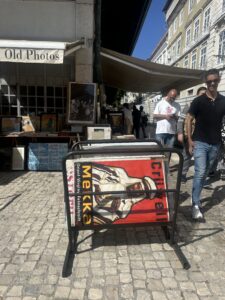
Expect to find second hand goods, such as vintage fashion, art, vinyl and collectibles, and bring cash, as many vendors do not accept cards. It is best to arrive earlier to find the best items, although late afternoon can provide bargains.
The market is held every Tuesday and Saturday from roughly 8am to 6pm at Campo de Santa Clara.
Is Lisbon worth visiting?
Don’t fret about not being made to feel welcome in this lovely city. Lisbon is absolutely worth visiting and is one of Europe’s top city break destinations, offering a mix of historic charm, stunning hilltop viewpoints, vibrant nightlife and affordable prices. It is a vibrant, apparently safe and welcoming city. Just be respectful.

Want more Portugal travel inspiration?
Read about a different side to Lisbon in Judith Fraser’s winter city break here.
You can find out about what to do on a city break to Porto here.
Please follow The Sun Lounger on social media:
https://www.instagram.com/thesunlounger/
@the_sun_lounger


