
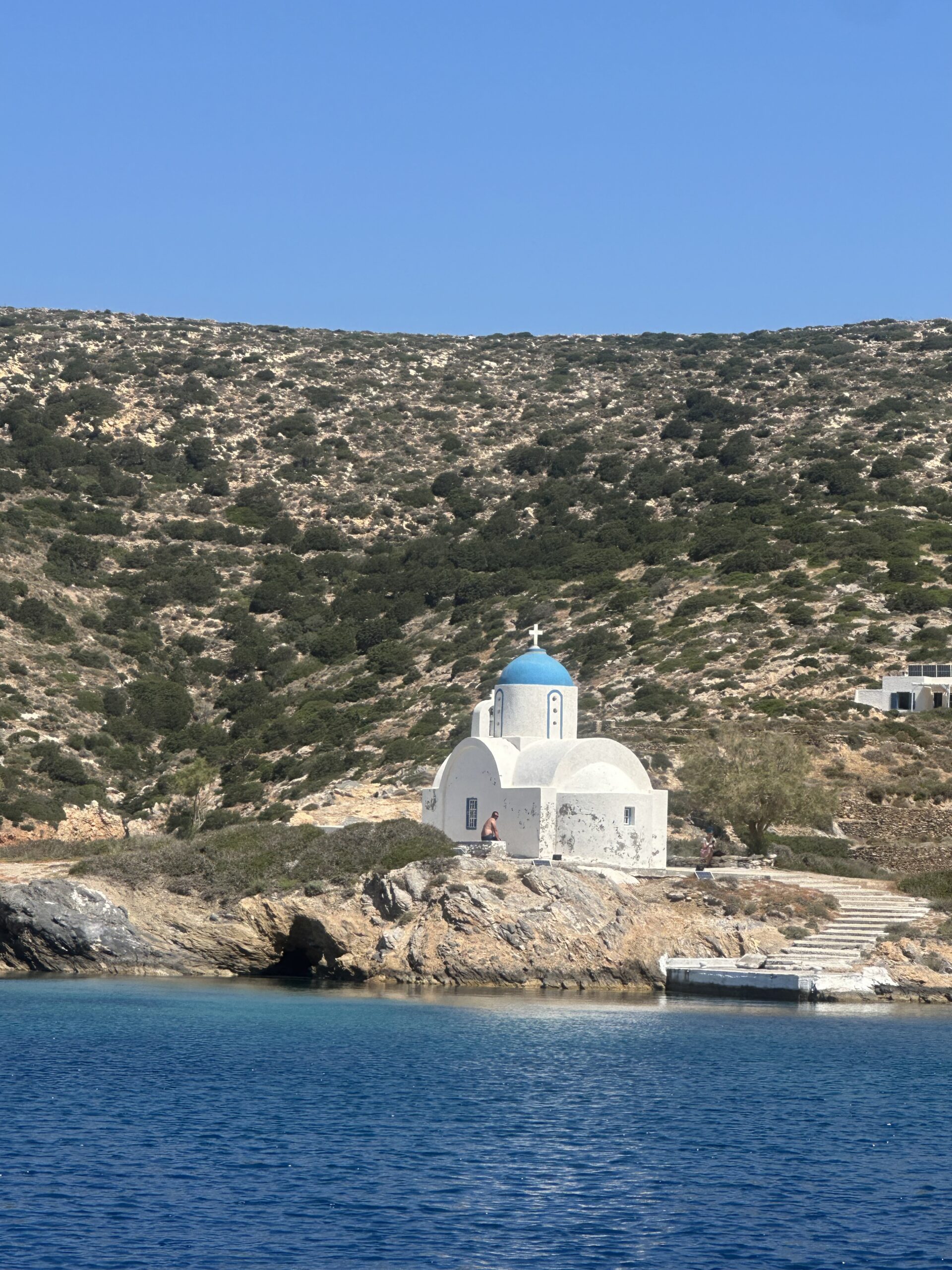
Sometimes, you visit a place that is undeniably beautiful, but the welcome is a underwhelming and you feel like just another tourist.
Other times, the people are warm and welcoming, even if the destination itself doesn’t live up to expectations.
And then, every so often, you find somewhere truly special. A place that feels untouched by mass tourism, where the scenery takes your breath away, the food is exceptional, the weather seems permanently set to perfection and the locals welcome you as though you’ve been part of the community for years.
When that happens, you know you’ve struck gold. For me, that place is Katapola on the Greek island of Amorgos. There, life moves at a gentler pace and visitors are welcomed with genuine warmth.
After spending a divine week in Andros with my two daughters last summer, we felt certain we wanted to explore more Greek islands. After all, there are about 6,000 of them – 227 of which are inhabited.
My mission was simple: find a quiet Greek island with sandy beaches, authentic tavernas and breathtaking scenery.
We wanted somewhere that felt like Greece before mass tourism arrived. A destination with traditional villages, crystal-clear water and friendly locals, rather than beach clubs, influencers and eye-watering prices.
While islands such as Santorini and Mykonos clearly appeal to many, I was searching for a more authentic and affordable alternative. A place where evenings revolve around simple, tasty food in family-owned tavernas, waterfront drinks and spectacular sunsets rather than VIP tables and designer boutiques.
After hours of research, Amorgos kept appearing on my shortlist. Here’s The Sun Lounger’s guide to a beautiful holiday on this very special island, where we were made to feel like family.
Where is Amorgos?
Amorgos is a Greek island in the Cyclades, the island group that also includes Santorini, Mykonos, Naxos and Paros. But it couldn’t be further removed than the first two!
Located in the south-eastern part of the Cyclades, Amorgos sits between Naxos and the Dodecanese islands, surrounded by the deep blue waters of the Aegean Sea.
Unlike some of its more famous neighbours, Amorgos remains refreshingly unspoilt. There is no airport, which has helped protect the island from mass tourism and preserve its authentic Greek character.
What is Katapola in Amorgos like?
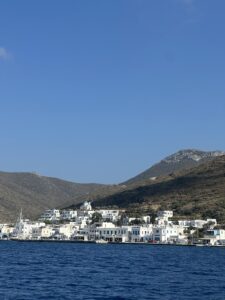
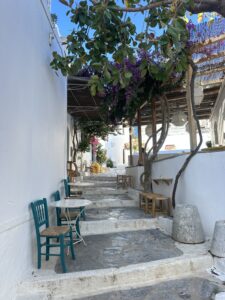
Looking at Katapola from the sea, it’s a small village divided into three distinct parts. To the right is the harbour, where you’ll find traditional quayside tavernas, cafés and small bars, with a few shops and cute little winding streets leading to your holiday accommodation.
Laying in your bed, you’ll hear the clanking bells around goats’ necks on the hills behind you and the occasional early-morning cockerel. It’s everything that you want from a Greek village and more.
In the middle is the working hub of the village – which has a permanent population of around 150 residents. Here you’ll find there’s a blue-domed church, supermarket and school. To the left of the horseshoe bay is where you’ll find most of the restaurants.
Despite being the island’s busiest transport hub, it never felt hectic or overcrowded – or at least it didn’t when we visited in June.
Unlike the in-your-face glamour of Mykonos or dramatic cliff-top Santorini, where people queue to take a photo of the view, Katapola’s charm lies in its authenticity. It feels like a working Greek village rather than a purpose-built tourist resort. You’ll find family-run tavernas instead of beach clubs and a pace of life that encourages you to slow down and stay a little longer.
For me, Katapola struck the perfect balance. It had enough restaurants and bars to keep things interesting, plenty of character and some beautiful swimming spots, yet it remained wonderfully relaxed and unspoilt. It’s exactly the kind of place that reminds you why you fell in love with the Greek islands in the first place.
If your ideal evening involves an Aperol by the harbour, catching a water taxi over to the most stunning of beaches, before wandering to a family-run taverna for dinner, you’ll probably fall for Katapola as quickly as I did.
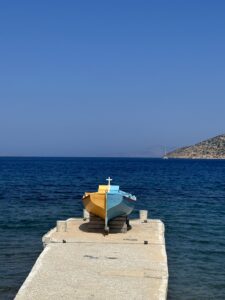
Who visits Amorgos?
Very little English, although the majority of islanders we chatted with spoke perfect English! There was a mix of nationalities on the beaches, but were told the most frequent visitors to the island are from France and Italy. We heard Germans, Antipodeans, Swedish and a few other nationalities.
The ferry from Santorini to Katapola was packed with American tourists, many of whom seemed considerably more ‘enthusiastic’ and/or ‘animated’ than we’re used to in Europe, shall we say! Few appeared to be staying in the village itself, which I wasn’t disappointed about.
There was a large sailing ship moored in the harbour when we arrived, occupied entirely by American tourists. Fortunately for those seeking peace and quiet, it didn’t stay long and the beaches returned to being wonderfully tranquil.
My sincere apologies to any American readers, but Europeans do sometimes marvel at your ability to hold a conversation at a volume that allows participation from neighbouring islands.
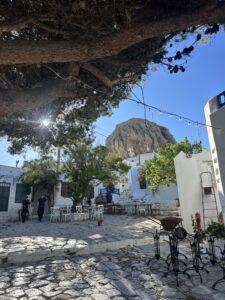
When to visit Amorgos
When we arrived at the beginning of June, some bars, restaurants and shops were only just opening for the season. At first, I was surprised. Then I realised this was exactly why I was falling for Amorgos.
Unlike many of Greece’s better-known islands, tourism hasn’t taken over every aspect of life here. The island still belongs to its residents first and visitors second. In a world of year-round resorts and overtourism, that’s becoming increasingly rare.
That said, I advise checking that bars and restaurants are open before booking your trip to the island.
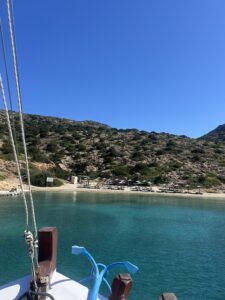
What are the beaches like in Katapola?
Katapola has two main beaches: Akrotiri, a thin strip of sand and pebbles a short walk from the port, and Maltezi (above), which is a little slice of heaven and best accessed by boat from the port.
Is Amorgos a friendly island?
Incredibly so. At first, it might not seem like it, but make an effort to speak to people and you will be made to feel so very welcome in return. We fell in love with many of the island’s characters, who welcomed us with open arms and shouted their greetings to us as we walked by every day.
Queen of Katapola for us was the wonderful Maria, who runs the bar at Maltezi beach. Life is, quite simply, better at Maltezi. Maria makes the most wonderful Greek salads, dakos, yoghurt with fruit, nuts and honey, toasted sandwiches and panini from her cabin on the beach. Not to mention her powerful mojitos – made with fresh mint from her own garden.
Maria told us that when she gave up smoking, she became addicted to Greek yoghurt instead and has to have one every morning, or she gets withdrawal symptoms. That’s an addiction I can get behind!
Maria potentially has the best commute in the world, on board the water taxi – Nomikos – which runs from the port every hour, on the hour, from 10am to 7pm. This service is operated by her family and costs €7 per person return, daily.
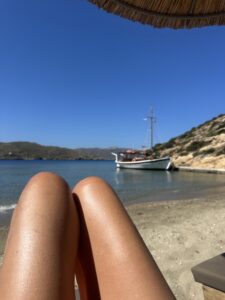
The captain (her son) was sporting a large plaster to the forehead when we were there, covering an injury sustained from a goat. That’s island life for you. He and his dad (Maria’s husband – a retired gent who could crack walnuts with his biceps) helped passengers on and off the boat at either end, always with a smile and a greeting.
A smiling lady called Stamatia owns the villa we stayed in (see below) and met us at the port with a beaming smile. She is a fountain of knowledge about the island and enthusiastically told us where to go and what to see while there. She also provided us with her mobile number and we messaged her several times during the week – when we were stuck in the island’s main town with no idea of how to get back, for example – and she always replied quickly.
Stamatia and Maria are friends, and the former’s daughter also runs a lovely eatery on the harbour called Teleion, where she makes amazing pancakes and mixes a top class Aperol Spritz.
The sun lounger guy on the beach, the lady we met at Maltezi taking her rescue dog for a swim, the taxi driver who bought us a bottle of local honey-flavoured raki as we prepared to leave the island, the super-friendly server who came with us to hear live music at the botanical gardens, the smiling car hire guy, the lovely lady from Bastet who helped me when I took a tumble wearing highly inappropriate shoes on uneven ground in the dark, post wine….the list of wonderful characters is endless.
Is Amorgos a cheap island to visit?
Yes and no. Don’t arrive on the island thinking that because it’s a quiet little piece of heaven, it’s going to be a backwater and dirt cheap. Andros was cheaper.
It is possible to find accommodation for €60 per night and to dine on the best gyros you’ve ever had for €4. But many of the restaurants have prices not too dissimilar to the UK (see below). Bear in mind that, while Amorgos residents will grow much of their food and fish no doubt comes straight from the Aegean, many ingredients will have to be shipped from the mainland.
What is there to do in Amorgos?
Don’t arrive wanting organised bar crawls and watersports. It simply isn’t happening.
When we could tear ourselves away from Maltezi Beach (I found this very hard to do), Stamatia had provided us with a map and told us the best places to go, so we took her advice and had a couple of days of low-key exploring.
Chora (pronounced: HOR-ah)
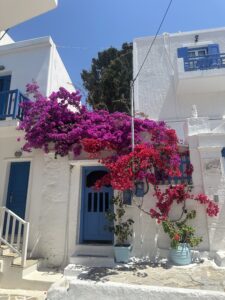
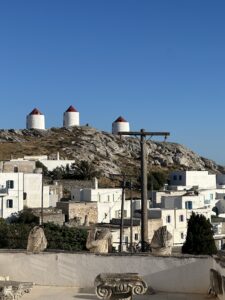
If Katapola is Amorgos’ welcoming front door, Chora (above) is its beating heart. Perched high above the sea, this whitewashed maze of narrow lanes, hidden courtyards, artisanal shops and flower-filled alleyways is the island’s capital and one of the most beautiful towns in the Cyclades.
Like many Greek islands, the capital is simply called ‘Chora’ – literally meaning ‘town’ – which can be confusing until you realise that everyone knows exactly which chora they’re talking about.
Stamatia told us the Amorgian Chora was the most beautiful of all choras…and I think she was right. In June, the town was almost empty, but we were told that the narrow lanes are heaving in August.
We took the advice of one of our other new Katapala pals and checked out an adorable place called Jazzmin, with its adorable rooftop and super-friendly manager. It has, we were told, the best view in Chora. I couldn’t argue.
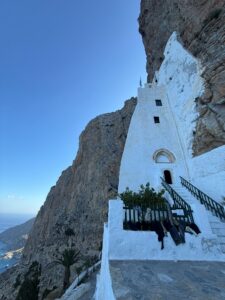
This kind of holiday activity is very ‘un-me’ but when my niece suggested visiting and lighting a candle for my dad, who passed away a few months before, I decided to lift myself from my sun lounger and do it. Stamatia recommended we visit in the afternoon, when the sun wasn’t on that side of the cliffs.
This vertically-stacked heap of pristine sugar cubes – the second oldest monastery in Greece – has precariously clung to this dramatic cliff face since before William the Conqueror invaded England.
It’s permanently inhabited by two monks, including island icon Father Spyridon Denaxas, who left school at 18 and joined the order up there. That was 50 years ago. Apparently he can sometimes be seen in island coffee shops.
Tradition holds that Byzantine monks fleeing persecution in the Middle East in the 9th century sailed to this mountainous island with an icon of the Virgin Mary. They were building a shelter in a cave when falling rocks revealed a chisel hanging farther up the cliffside.
Taking it as a sign, they spent the next decades constructing the monastery more than 150 metres (500 feet) above the sea, where both the icon and the chisel are still on view in the small chapel that anchors the complex.
We climbed through its tiny door, put on the long skirts and shawls provided, felt the instant calm, lit a candle for our dad/grandad, sobbed, watched the goats, cats and chickens outside, marvelled at the view, received some water, raki and sweets from one of the monks and then climbed back down.
Entry is free, although donations are welcome.
Kalotaritissa Beach and Shipwreck of Olympia
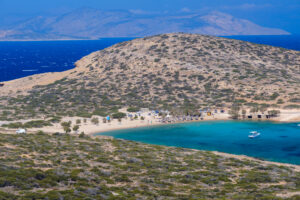
Stamatia recommended several of the island’s beaches to us, but Kalotaritissa has the winning combo of sand (not pebbles), sun loungers for hire and a beach cafe, so we headed there.
Driving over the headland, you are greeted by a stunning, almost elliptical, sheltered bay, with dancing fishing boats, turquoise water and a tiny shack serving the few visitors who make it here.
We were told by the young lady who served us that her mum made everything to order, so we had the homemade meatballs which were delicious.
We didn’t make it to the shipwreck, but saw it from the coastal road.
Tip: take cash with you because wifi is patchy at several of the beaches we went to on the island.
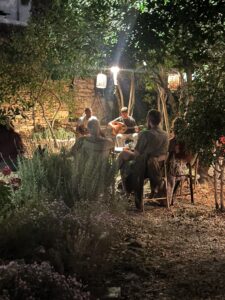
Botanical Gardens, Katapola
Don’t go here expecting Kew Gardens. The botanical gardens in Katapola are more of an adorably cute park where they serve breakfast and cocktails, and where you can do yoga, watch a film in an occasional open air cinema or listen to live music.
Boat tours of the island
This is something we tried to do but failed at, miserably. While in Katapola, we called, messaged and tried to doorstep a luxury yacht reportedly operating tours of the island, but we never received a reply. Maybe they weren’t ready for tourists yet.
We did find another – Roussetos daily cruises – but they departed from Kalotaritissa, where we had already been and would have preferred a Katapola departure so we didn’t get the chance to cruise to beaches only accessible by boat. We were quoted €500 for four people. Next time!
We hired a car from FM Rent a Car in Katapola for just €40 a day, which was without doubt the easiest car hire interaction I have ever had. I’d recommend hiring an automatic purely because of the hairpin bends and 45 degree angle roads of the island.
We took a bus from Katapola to Chora (€2 each) and a taxi back for €10. Yannis from Midnight Express taxis was a true gent and told me I had orange eyes! I think he was commenting that the sunset was reflecting in my eyes, but I can’t be sure!
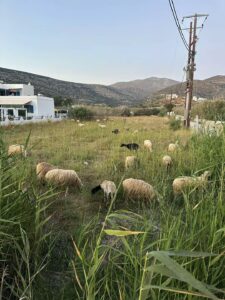
Wildlife in Amorgos
Whether it’s because Katapola is untouched by mass tourism or the island is a little more remote that others, but nature is all around you on Amorgos. Aside from the cats – of which there are many – you’re also likely to happen upon other forms of wildlife.
The most exciting and unexpected for us was what we initially thought was an otter, then a pine marten, which we encountered on several occasions, later discovering that it was in fact a beech or stone marten, which are apparently reasonably common on Amorgos.
These creatures – about the same size as a cat, but longer and more slender – can often be found near humans. They are solitary and nocturnal, meaning you are most likely to spot them at night, as we did – three times.
You will hear domestic goats at night (they are also on the menu everywhere), but we also spotted some wild ones near Maltezi beach.
In the water, small shoals of white sea bream, ornate wrasse and Mediterranean damselfish will swim up to you, seemingly unafraid of humans!
Best places to eat and drink in Katapola, Amorgos
The waters edge is adorned with many great eateries, so wander and see what takes your fancy. Here are a few of our favourites:
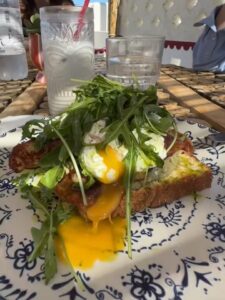
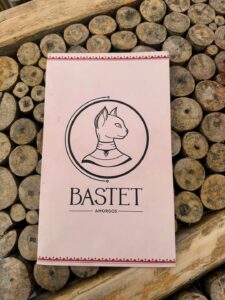
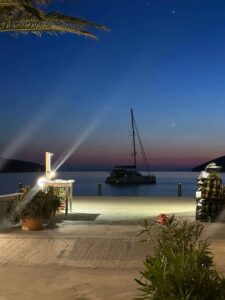
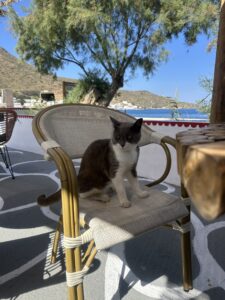
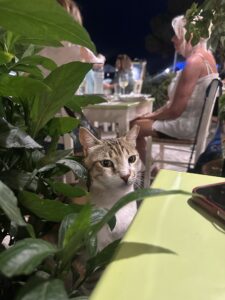
We had brunch here most mornings, enticed by the great views, marvellous menu, lovely staff and cats! Our favourite was a grey and white one we called Smokey, who was full of attitude and could sometimes be a bit grumpy, which we respected him for. However, one day, he went and found my two daughters on the beach and was in his best mood ever.
For breakfast or brunch, think Greek yoghurt with tahini, bitter chocolate, peanut butter and banana or try the shakshuka with feta, banoffee overnight oats or poached eggs with local bread and avocado.
Breakfast for four: around €75
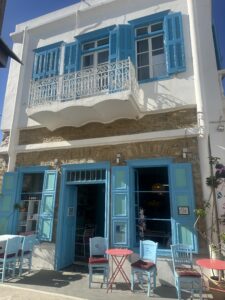
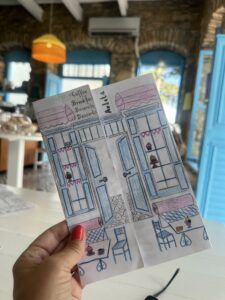
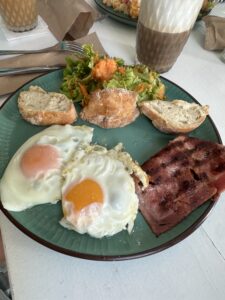
You’d be hard pressed to find anywhere more Instagrammable on the whole island than Arleta. The lady owner is the most cheerful, charming person and the food itself is ridiculously pretty. Adding to the cuteness factor is the hand-written menu.
We were greeted on arrival with a plate of complementary pastries – something like a baklava, but filled with custard. Portions were huge and we also bought some cute little mementos while we were there.
Breakfast for four: around €75
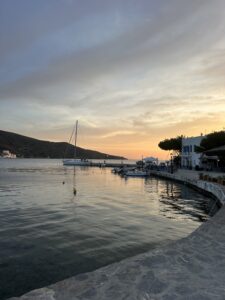
“Greek food with a twist of the world” is how this scenic waterfront eatery at the far end of the bay describes its cuisine and we liked it so much that we ate there twice in the evening and once for brunch.
The highlight for me was the simple green salad with orange dressing and raisins. I had to go back to have it again. Service from two brothers was spot on and the location itself is probably one of the best in the village.
Dinner for four with wine and cocktails: around €150
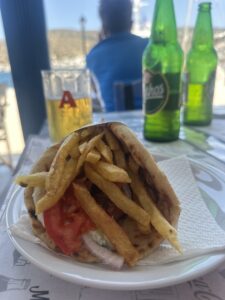
Right on the harbour, with views across the bay, this is the place for delicious, hearty gyros for only €4 each. My daughter is a Greek salad connoisseur and utterly loved hers. We ate here two or three times and every time was spot on!
Come here for excellent food and friendly, welcoming staff (who told us we had great auras). I adored the delicious youvetsi (beef stew served with orzo pasta) and moussaka which was served inside a hollowed out aubergine.
Main courses were between the €10 and €18 mark and judging by the amount of hugging going on, it has several repeat customers. I would go again in a heartbeat.
Moon Bar is where it all happens after dark and the place the young and beautiful go to get slightly lairy. Beautiful vibes, views and cocktails.
Where to stay in Katapola, Amorgos
The four of us enjoyed seven peaceful nights in two rooms at the simply perfect Villa Katapoliani in the centre of the village, in a quiet, narrow cobbled lane, just a few steps away from the port. There are nine rooms in the enchanting Villa 1 with ridiculously pretty gardens. All rooms have a private balcony or terrace and many overlook the ancient ruins of Apollo’s temple.
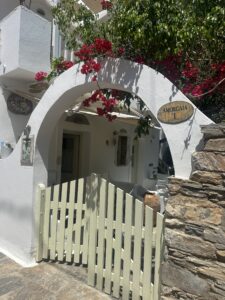
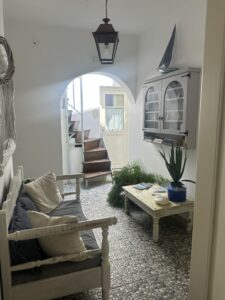
I had the smallest room in the house (room 8) which was absolutely perfect for me and its little balcony provided glimpses of the sea. My daughters stayed in cute room 102 with its small but perfect terrace. It has a third fold down bed, which was great for my adult niece.
The rooms are all tastefully decorated and cleaned daily. In fact, they are so clean, you could eat a meal off the floor!
I wouldn’t want to stay anywhere else, although owner Stamatia does have two other properties in the village – a studio virtually on the nearby beach and another a walkable distance out of the centre of Katapola, with four separate apartments.
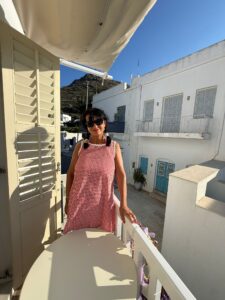
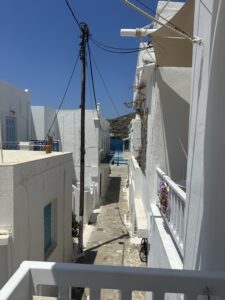
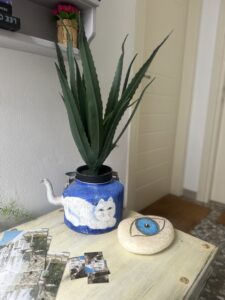
Prices in Villa 1 start from around €70 per apartment a night in June.
What’s the best way to get to Amorgos?
We flew from London Stansted to Santorini with Ryanair (approx £250 per person for basic flights) and stayed overnight in Megalochori, not far from the ferry port, on both legs, as crossings and flight times didn’t marry up.
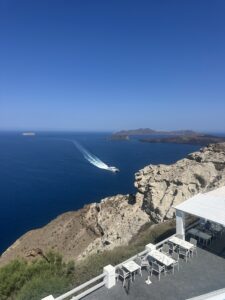
Wherever you fly to, you’ll need to get a ferry to the island. There are three options:
- Santorini to Katapola: this is the shortest crossing (between one and two hours). Our crossing with Seajets cost just under €80 each way. I’d recommend sea sickness tablets, as it can get mighty choppy out there!
- Mykonos to Katapola: crossing time is 2-4 hours
- Athens (Piraeus) to Katapola: this is the classic route and flights from the UK to Athens are aplenty. However, the ferry journey takes approximately 5.5 to 9.5 hours, depending on the vessel. The advantage is that there are usually more ferry options and it can be cheaper. The disadvantage is that you lose most of a day travelling.
Book directly with the ferry company and you avoid a handling charge, but you need to check in 24 hours before the crossing, which can be a little tricky on your phone.
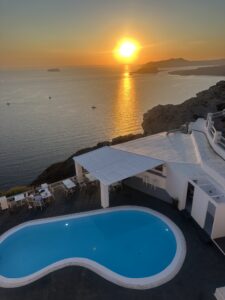
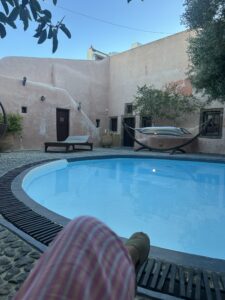
We needed overnight stays in Santorini either side of the holiday and chose Megalochori, not far from the ferry port. We loved both Artemis Suites (above), with its marvellous sunset views over the Caldera (£217 for a suite for three people for one night), and Ducato Wine Village (below), who upgraded us to a three-bedroom villa with private pool on arrival (£160 for four people for one night).
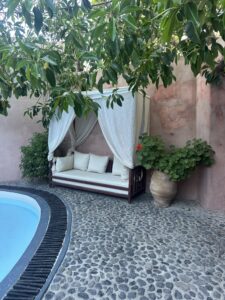
If you are hanging around for a late night flight, like we were, it’s worth phoning around and seeing if you can get a day pass at any of the hotels with views over the Caldera. We were made to feel very welcome at Grand View Hotel (below), just along from Artemis Suites.
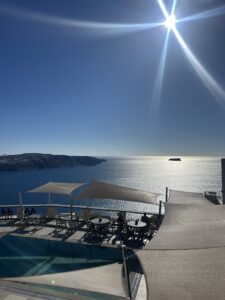
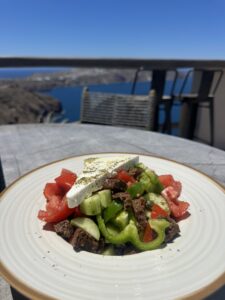
There was no charge, as long as we ate and drank at their restaurant, which was hardly a chore – with its spectacular views.
Santorini, which reminded me of a large chocolate brownie sticking out of the sea, peppered with sugar cube houses, felt like a metropolis after the peacefulness of Amorgos. I’m personally not sure I would rush back to the island itself, but then I feel we may have been spoiled by perfect Katapola.
Would I go back to Amorgos? Yes, in a heartbeat. Will I go back? I’m not sure. While I long for its loveliness, I feel there are also so many more wonderful, equally remote and unspoilt Greek islands yet for us to explore.
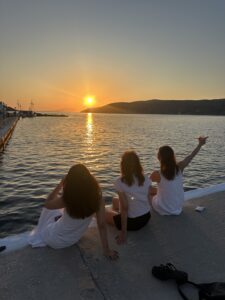
Liked what you read and want more Greek holiday recommendations? See below:
- Click here for a review of Batsi, Andros
- Learn about island hopping in the Cyclades here
- Find out about house sitting in mainland Greece here
Please follow The Sun Lounger on social media:


