
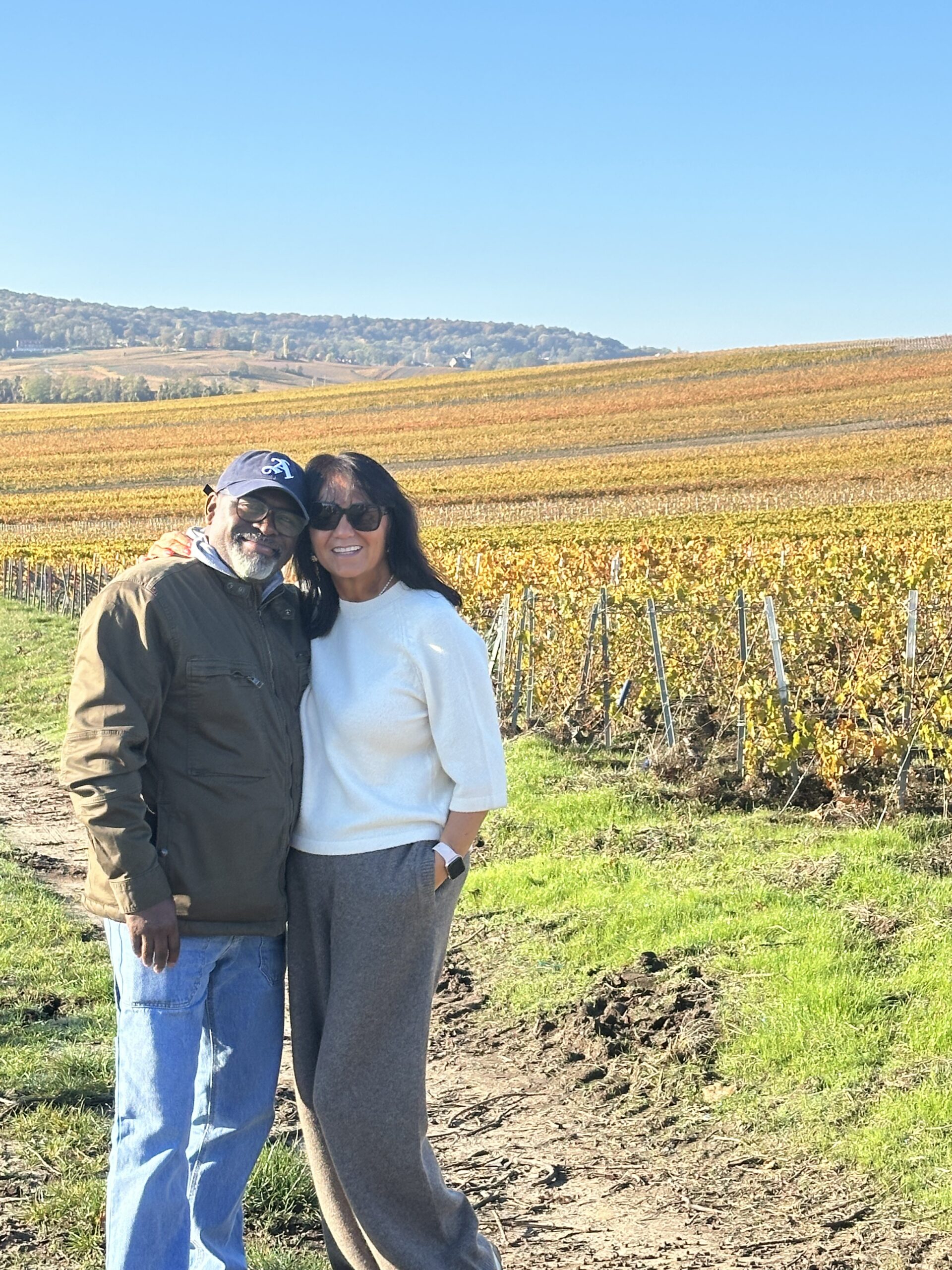
Champagne is far more than just a product from a corner of north-eastern France – an area a fifth of the size of Greater London. It’s an entire way of life and an industry worth an astonishing €5.7 billion a year.
It is the very identity of the region.
Here, entire communities, generations of families and vast stretches of countryside are devoted to the production of a drink that has become synonymous with luxury, celebration and indulgence.
I’ve driven past the vineyards of the Champagne region, en route to Spain, several times -glancing at the rolling hills and seemingly endless rows of vines, without giving much thought to what goes on behind the scenes.
But it wasn’t until I visited in October this year, on a day trip from Paris with the lovely Will from Bluefox Travel, that I fully appreciated the extraordinary scale of the Champagne industry in this part of France.
Visiting on a bright autumn day – when the turning colour of the leaves created a beautiful patchwork landscape – I saw that every tiny scrap of land here is dedicated to growing and producing champagne. From vast rolling, commercial vineyards to verges and back gardens. All champagne.
From vast co-operatives producing millions of bottles to literally hundreds of tiny, family-run vineyards where generations have devoted their lives to perfecting their craft, I discovered a world that extends far beyond the contents of a champagne coupe.
It turns out there’s significantly more to champagne than simply popping a cork.
I am wildly suspicious of day trips – largely due to the less-than-perfect experience I had at Suluada Island in Turkey, this summer. But this one, which saw us getting up at 5.30am to meet our transport outside a café in central Paris at 7am, was utterly worth the bleary eyes.
Before the trip, I was rather concerned about potentially being in a van full of notoriously loud Americans for 11-12 hours (I am sorry, but you do have a reputation for creating more decibels than some Europeans can manage).
What followed was a perfect day where new friendships were made, much Champagne was consumed and significant knowledge was gained.
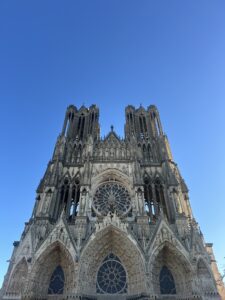
Reims Cathedral: where French kings were crowned
Champagne isn’t the only reason to visit this part of France and our first stop of the day, expertly timed arrive before the crowds of the day and around 90 minutes from central Paris – was the rather magnificent Notre-Dame de Reims Cathedral.
First of all, how to pronounce ‘Reims’. I can guarantee that most of you are doing it incorrectly, as indeed I was. Our highly knowledgeable and very welcoming tour host, Will, who spoke perfect English, told us it is pronounced ‘Rance’ (or Rahnss) – not ‘Reems’. I stand corrected.
I am not a huge church/cathedral fan on holiday, but this one – a UNESCO World Heritage is well worth a visit. It’s one of France’s most important historic buildings and has witnessed the coronations of 25 French kings. One of the most famous was Charles VII, who was crowned here in 1429, with Joan of Arc present at the ceremony.
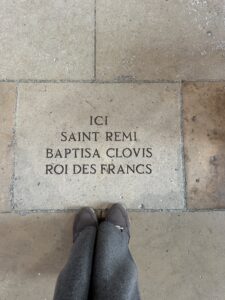
Clovis I was the first king to unite the then present, differing tribes under one ruler and is regarded as a founding figure of France. He was baptised at the cathedral in around 496 AD, when Britain was in the midst of post-Roman and Anglo-Saxon settlement.
His conversion was a defining moment in French history, helping to establish Christianity as the dominant religion of the Frankish kingdom. The cathedral It’s a reminder that this region has an extraordinary history that extends well beyond the vineyards.
One statue stands out among the 2,000 or so which adorn the cathedral and that’s of the 13th century Smiling Angel, or L’Ange au Sourire. Unlike the rather painful expressions you might expect from medieval religious statues, this angel has a distinctly cheerful smile.
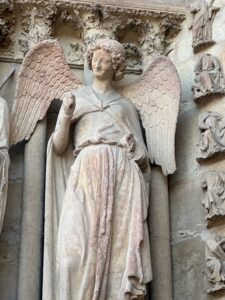
During the First World War, Reims Cathedral was badly damaged by German shelling and this statue lost its head in a fire in September 1914. The damaged statue became a symbol of the destruction of French cultural heritage during the war.
It was subsequently restored and today the smiling face has become one of the most recognisable symbols of Reims and a defiant V-sign standing against war and destruction.
Champagne: a few facts that surprised me
Only just into the journey, someone asked what the difference is between champagne and prosecco. To be called champagne, it must come from the designated Champagne wine-growing region in north-eastern France and be produced according to strict rules governing everything from the grapes used to the way the wine is made.
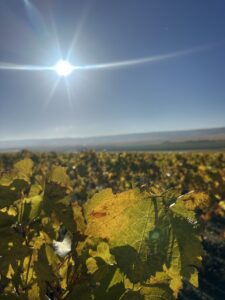
Here are some more champagne trivia:
- Although the region is famous throughout the world, the actual vineyard area is surprisingly small. There are approximately 34,200 hectares of vineyards (342 square kilometres), equivalent to around 84,500 acres, spread across 319 wine-growing villages.
- Champagne accounts for just 0.5% of the world’s vineyard area, yet represents around 31% of the global sparkling wine market by value.
- Google tells me there are approximately 16,460 grape growers, 410 champagne houses and 120 cooperativesin the region, but our guide said there were more than that – perhaps between 5,000 and 6,000 different houses, some producing purely for their own village.
- Not all those growers make their own champagne. Many sell their grapes to larger houses, while thousands produce and market champagne under their own labels, either independently or through cooperatives.
- In 2025, approximately 266 million bottles of champagne were shipped, with more than half heading overseas.
- The UK is one of Champagne’s biggest export markets, which suggests I’m certainly not alone in my enthusiasm for the stuff.
The vineyards: where the magic begins
One of the loveliest parts of our day was driving through the Champagne countryside and stopping to take in the vineyards, which stretch across the pristine, golden hills. But behind those picturesque scenes is an enormous amount of hard work.
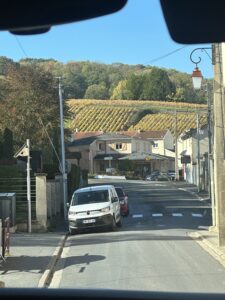
One of the things I hadn’t appreciated is that all grapes used to make champagne must be harvested by hand. Mechanical harvesting isn’t permitted. It means that every year, huge numbers of seasonal workers descend on the region to pick the grapes during the relatively short harvest period. When we arrived, it felt rather sleepy – as if everyone was having a rest after the furore of the harvest.
The three main grape varieties used in champagne production are Chardonnay, Pinot Noir and Meunier. Interestingly, two of those – Pinot Noir and Meunier (which I thought was a way of cooking sole) – are dark-skinned grapes, despite much champagne being white.
The trick is in the pressing, which is done carefully to prevent too much colour transferring from the skins into the juice. And it takes roughly 1.2kg of grapes to produce a single standard bottle of champagne.
Rosé champagne can be created from dark-skinned grapes, but more likely from adding red wine to clear champagne, I learned!
Champagne Delaunois-Chanez: five generations of family winemaking
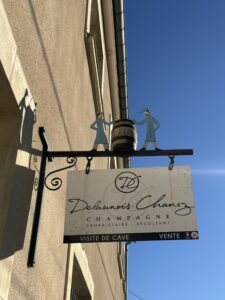
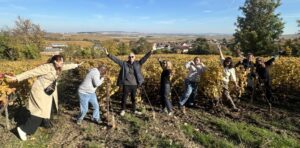
The highlight of our day was visiting Champagne Delaunois-Chanez, a small, family-run producer in the village of Rilly-la-Montagne, a Premier Cru village – a designation recognising the historical quality of vineyards in the region. Here, we met Élodie Chanez, who took over the family vineyard from her father, Éric, whom we also met, in 2017.
Her family has been making wine for five generations, with the business dating back to the 1920s. It’s a wonderful example of the smaller, independent producers that are such an important part of the Champagne region, seemingly producing gallons of delicious bubbles from their garage extensions.
While the larger vineyards bring together thousands of growers to produce their vast quantities, Delaunois-Chanez cultivates just 3.8 hectares of vineyards, or around 9.4 acres. Élodie grows all three of Champagne’s main grape varieties and the family produces champagne from grapes grown on its own land.
Unlike the larger champagne houses, which may source grapes from hundreds or even thousands of growers, Delaunois-Chanez controls the process from vineyard to bottle, including pressing and winemaking on the premises.
Their non-vintage champagnes spend at least two years ageing, while their vintage champagnes are aged for at least four years – longer than the minimum periods required by Champagne’s regulations.
Among their champagnes are Sublime Brut, Royale Rosé, Cuvée du Fondateur, Blanc de Blancs and a rather special champagne called Cuvée Élodie – their most expensive bottle.
It’s one thing to drink champagne from a famous label. It’s quite another to meet the person who grows the grapes, makes the wine and puts their own name on the bottle.
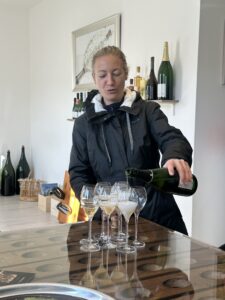
I’m not sure I have never wanted to be someone more than I wanted to be Élodie – an endless supply of champagne at her fingertips, working from home, killing it in an industry dominated by men and with a champagne bearing her name. The dream!
And while the grand champagne houses are undoubtedly impressive, I think visiting a smaller producer gives you a much more personal appreciation of the work that goes into every bottle.
You can buy champagne during your visit (we did) and what you can’t carry home with you, Élodie can ship for you.
Nicolas Feuillatte: a very different kind of champagne house

Our second champagne house visit was to Nicolas Feuillatte, located in Chouilly, just outside Épernay. Unlike some of the centuries-old champagne houses, Nicolas Feuillatte is a relative newcomer, but holds number three position in the market – behind Moet et Chandon and Veuve Clicquot.
And I have some in my fridge – a birthday present from a friend!
The brand was created in 1976 by its namesake – a French businessman who had made his fortune importing African coffee into the US. He initially created champagne for his American friends, with early customers reportedly including the Kennedys and Aristotle Onassis.
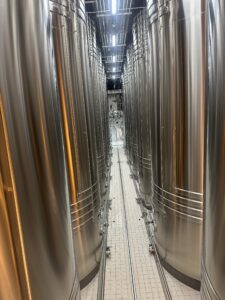
Nicolas Feuillatte doesn’t grow all of its own grapes, but is cooperative. It brings together approximately 5,000 winegrowers; whose grapes contribute to the production of its champagnes.
The cooperative represents more than 2,000 hectares of vineyards, drawing on grapes from different parts of the Champagne region. This gives its winemakers an enormous variety of grapes and wines to work with when creating their blends.
It takes some skill to be able ensure that each year’s vintage tastes the same and upholds the same standards – and that is a craft I am willing to learn!
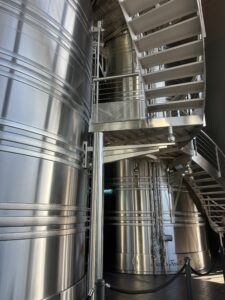
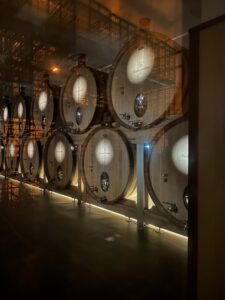
This is champagne production on a vast scale, manufacturing somewhere in the region of 25 million bottles a year in 446 vast fermentation tanks and being exported to 80 countries.
The vast champagne-making facilities are modern and while picking of the grapes is done by hand, much of the production appears to be done by machinery and robots. I have to admit, I prefer Élodie’s set up.
How champagne gets its bubbles
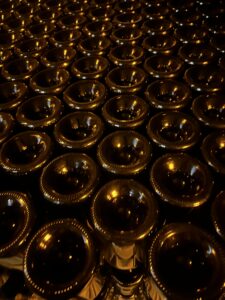
Champagne matures in the bottle – not in massive vats of the fizzy liquid. And incidentally, there can be up to a million bubbles in every bottle!
Champagne gets its bubbles through a second fermentation, which takes place inside the bottle. A mixture of wine, sugar and yeast is added before the bottle is sealed with a temporary cap. The yeast converts the sugar into alcohol and carbon dioxide, creating the bubbles that become trapped inside.
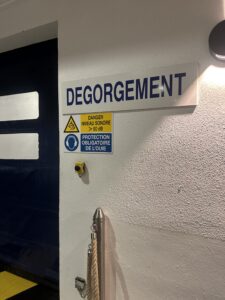
My favourite stage in the slow production of champagne is called disgorgement. After the bottles have been gradually tilted and turned over a long period of time, so that the sediment gathers at the top, the necks are dipped into a freezing solution, causing the champagne to form a small plug of ice containing the sediment.
When the time is right, the temporary cap is removed and the pressure inside the bottle forces the frozen plug to ‘pop’ out, taking the unwanted sediment with it. The bottle is then topped up with a small amount of wine, often mixed with sugar, before being sealed with its familiar mushroom-shaped cork and wire cage.
Avenue de Champagne: the world’s richest street?
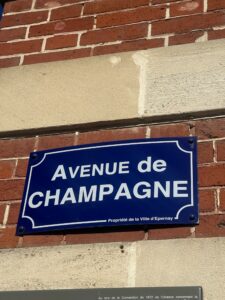
A street I would like to live on is Avenue de Champagne in Épernay – an elegant boulevard lined with grand mansions, impressive gates and some of the most prestigious champagne houses in the world. Among the famous names you’ll find here are Moët & Chandon, Perrier-Jouët, Mercier, Pol Roger and De Castellane.
The avenue is around 1.5km long and became particularly important to the champagne trade during the 18th and 19th centuries, when wealthy merchants established their businesses and built magnificent homes here.
But the really extraordinary thing about Avenue de Champagne isn’t what you can see above ground. It’s what’s hidden beneath your feet. Will (below), told us that this was one of the most expensive streets in the world, which sounded rather impressive – not because of its property prices, but because of the extraordinary amount of champagne stored in the underground cellars.

Beneath the avenue and surrounding streets is a staggering 110km network of underground cellars, carved into the chalk, where an estimated 200 million bottles of champagne are stored and left to mature.
It’s an extraordinary place and one where the real wealth is quite literally beneath your feet.
Dom Pérignon: the monk who didn’t invent champagne
My lasting memory of Épernay will always be dashing to buy some lipstick, kindly assisted by Will, after a lunch of snails and tuna tartare at La Flech in the champagne town’s Place de la République. But that’s another story!
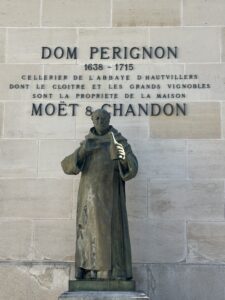
In the car park of the nearby Moët HQ, you’ll see a statue commemorating one of the most famous names in champagne history: Dom Pérignon.
Despite the popular story that he discovered sparkling wine and exclaimed, “Come quickly, I am tasting the stars!”, there is no reliable historical evidence that the Benedictine monk ever uttered those words.
What Dom Pérignon apparently did do, however, was help improve winemaking techniques, particularly grape selection and blending, helping to establish the reputation of wines from the Champagne region. Today, his name lives on through the prestigious Dom Pérignon champagne brand, which is produced by Moët & Chandon.
A few things I learnt about tasting champagne
One of the pleasures of visiting different producers is discovering how much champagne varies. Some are fresh, light and citrusy, while others are richer, fuller and more complex. Do you need to know the difference between brut and demi-sec? Probably but also probably not. Just enjoy what you like.
‘Vintage’ doesn’t mean it’s older, but that it’s been made using grapes from a single harvest year, whereas ‘non-vintage’ is usually blended from wines made in different years to maintain a consistent style.
And apparently, the traditional tall champagne flute isn’t necessarily the best glass for tasting it. Everywhere we went, we were served champagne in tulip-shaped glass, with a wider bowl and narrower opening, which allows the aromas to develop more fully, we were told.
Another useful tip is not to serve champagne too cold. Around 8-10°C is generally recommended, as excessively cold temperatures can suppress some of the flavours. I’d better get my bottle of Nicolas Feuillatte out of the fridge, then.
This is all very useful information for someone who has spent years simply opening the bottle and drinking it.
Would I recommend a champagne tasting trip?
Absolutely. There is so much more to champagne than the famous labels and expensive bottles. It’s about the landscape, the history, the extraordinary craftsmanship and the thousands of people whose lives revolve around producing one of the world’s most celebrated drinks.
I much preferred visiting a smaller producer over a larger one and I’d suggest booking a guided tour if you want to visit several producers in one day. Apart from the convenience of having someone organise everything, you benefit from local knowledge and can discover places you might otherwise miss. And, of course, nobody has to drive or navigate public transport after several vintages!
We came away having tasted some surprisingly different champagnes (three glasses at each house, plus more over lunch), learned an enormous amount and experienced another stunning part of France – my favourite country – that I’d happily return to.
The drive back to central Paris in heavy traffic was much quieter than the journey earlier that day – with all eight passengers (two Brits and six Americans) catching some shut eye after the amount of champagne consumed.
As for the noisy Americans…I think I created more decibels than they did, to be honest. Vive la difference!
Some practical information
Where: Champagne region, north-eastern France, particularly Reims, Épernay and the surrounding villages.
Getting there: Reims is a 90-minute drive from Paris, or approximately 45 minutes by high-speed train from Paris Gare de l’Est on direct services. Épernay can also be reached by rail.
Our guide: I’d highly recommend a small group tour with Will from Bluefox Travel in Paris (tickets €230 per person, including transport, entry into two champagne houses and Reims cathedral). Lunch is extra.
Booking advice: If not joining an organised tour, reserve champagne house tours in advance, particularly at weekends and during busy periods. Smaller producers may only accept visitors by appointment.
Avenue de Champagne: Free to explore on foot, although champagne house tours and tastings are charged separately.
Champagne producers we visited:
- Nicolas Feuillatte:Chouilly, near Épernay. Guided tours and tastings are available by reservation. Ours (tour and 3 glasses of champagne): €30 per person. Website: nicolas-feuillatte.com.
- Champagne Delaunois-Chanez:17 Rue Roger Salengro, 51500 Rilly-la-Montagne. Family-run Premier Cru producer offering cellar visits and tastings by appointment. Cellar tour + tasting of 3 vintages: 20. Website: champagne-delaunois-chanez.fr.
If you enjoyed reading about this French adventure, you might enjoy these:
Found what you just read useful? Please subscribe to The Sun Lounger for more travel news, reviews and interviews.
Please follow The Sun Lounger on social media:


