
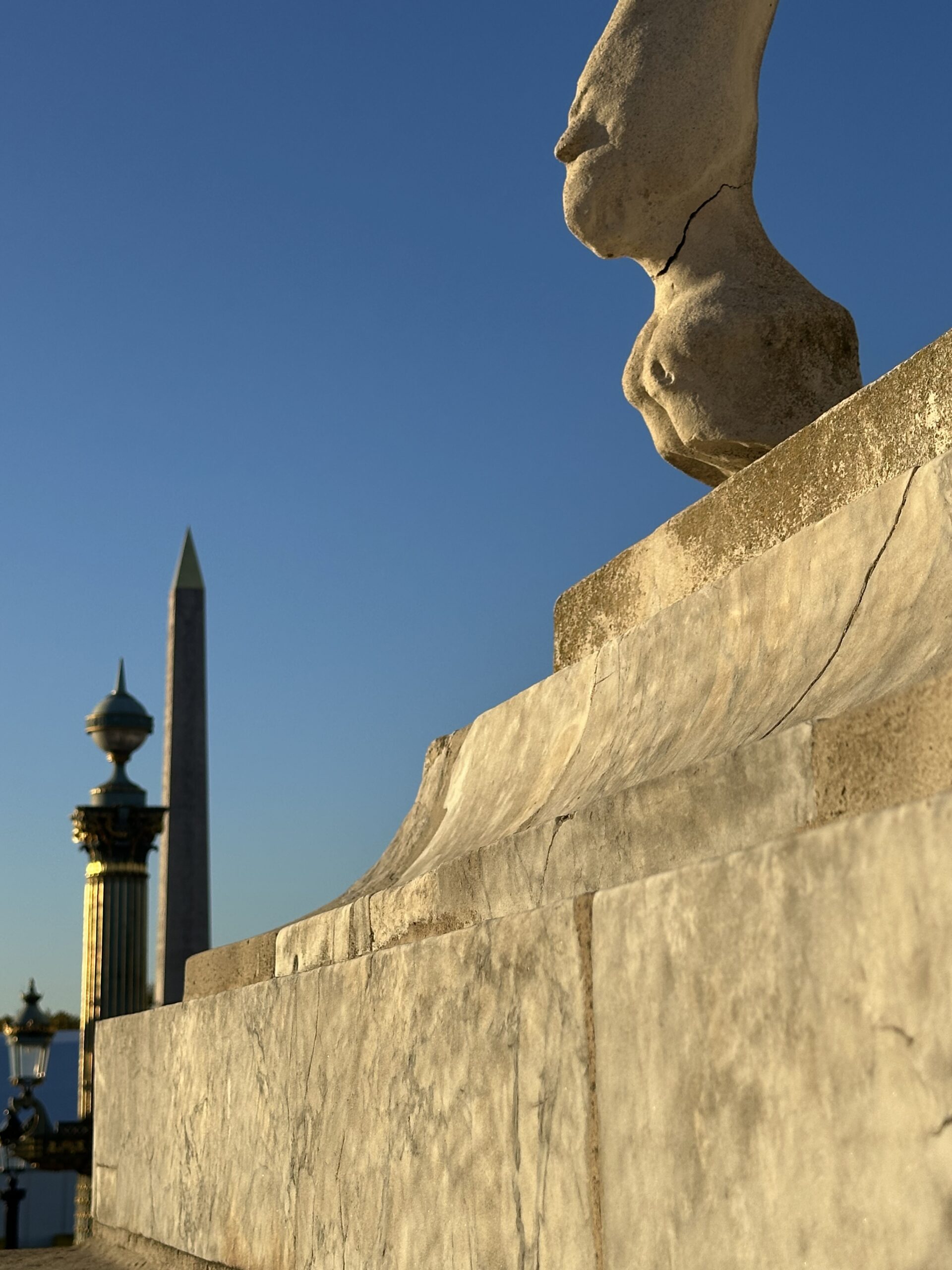
Following in the footsteps of my dad. This one’s for you, Bill!
There’s a condition called Paris Syndrome, where visitors are so disappointed by the reality of Paris that they experience genuine psychological distress. Personally, I suffer from the opposite. I simply cannot understand how anyone could visit Paris and not fall in love with it.
Paris, it appears, is like Marmite. People either love it with a passion or detest it – also with a passion.
The architecture, grand boulevards, pavement cafés, stereotypical little bistros, cobbled streets and the occasional garden oasis in an otherwise bustling city. What’s not to love? Yes, there are areas of the city that it’s probably best for tourists to stay out of. But isn’t that the same in any major global city?
I find it a magical, romantic, dreamy city – even if we were visiting between the demonstrations in October 2026 and the night before we left to catch the Eurostar, I was watching reels of windows being smashed, shops being looted and cars set on fire!
My partner and I arrived without much of a plan of what to do, other than to go to Notre-Dame. I’ve visited Paris a few times before and have always used Ubers or the Métro to get around. But my most recent trip gave me an entirely different perspective on the French capital.
When we checked in, our hotel receptionist produced a map and started scribbling on it: places worth seeing and where to eat. He gave us one piece of invaluable advice: “Walk everywhere.”
That, my friends, was the best bit of advice I’ve had in a long time.
A very personal reason for visiting Paris
This particular trip wasn’t purely about sightseeing, shopping or eating all the lovely food. I had a rather special mission.
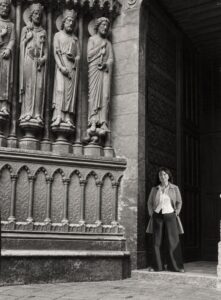
My dad, who passed away earlier this year at the age of 91, had visited Paris as a young man in the early 1950s. When sorting through his possessions at the home he shared with my mum, among his photographs was a black and white picture of him standing outside an impressive doorway (below). Other pictures in the same album enabled me to establish that this doorway was in Paris.

A quick bit of research revealed that he was standing in a doorway at the main facade of Notre-Dame Cathedral in Paris. When my partner told me he had booked us a trip to the French capital, I decided that, 74 years later, I wanted to recreate that photograph. Same location, same pose, same backdrop. Just a different generation.
Upon returning the UK, after our Paris trip, I also found that my dad took much the same route around the city when he visited in 1952, as you will see below.
But while recreating the photograph was my main objective (read to the end), the trip also reminded me why Paris remains one of my favourite European cities. And why, if you’re visiting, I recommend seeing as much of it as possible on foot.
Discovering Paris from South Pigalle
My partner had bid on and won a package for a trip to Paris at a charity event he went to. Therefore, he had little choice in the hotel we found ourselves at.
That said, the original hotel options positioned us way out of the centre of town – almost an hour away – so he paid extra to be closer to the centre. It was completely by chance, therefore, that we ended up at ZE Hotel – a quirky boutique hotel in South Pigalle, an area that turned out to be a brilliant base for exploring Paris.
The hotel itself was much better in person than it appeared online – with rooms starting at just €130 per night, which is phenomenally cheap for a hotel in central Paris. It was clean, friendly and had exceptionally good breakfasts, served by cheery ladies.
South Pigalle, sometimes referred to as SoPi, sits just below Montmartre and has become one of the city’s more fashionable neighbourhoods, with independent shops, restaurants, cafés and traditional Parisian streets. It’s lively without feeling touristy and there’s a real neighbourhood atmosphere.
We arrived in the afternoon on a weekday and wanted to explore locally before dinner – a restaurant I had booked in advance, I thought.
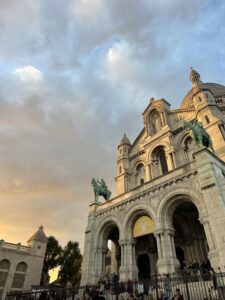
From the hotel, our hotel receptionist explained, we could walk uphill towards Montmartre and Sacré-Cœur. No complicated transport arrangements. No navigating the Métro. Just walk.
Normally, I’d have looked at a map, decided everything was miles apart and jumped into a taxi or underground station. But this time we took his advice. And I’m so glad we did.
Paris is more walkable than you might think
One of the biggest surprises was discovering just how manageable central Paris is on foot. Of course, Paris is a large city and I’m not suggesting you can walk from one end to the other in half an hour.
But many of its most famous landmarks are much closer together than you might imagine. The historic centre is relatively compact and the city lends itself beautifully to exploring one neighbourhood at a time.
Better still, Paris is a city where the journey between attractions is often every bit as enjoyable as the attractions themselves.
One minute you’re walking along an elegant boulevard lined with beautiful Haussmann buildings. The next, you’ve turned into a quiet little street with an old-fashioned bistro with checked table cloths, a florist or a tiny café that looks as though it hasn’t changed in 100 years.
You notice things you would never see from the back of a taxi or underground on the Métro. And, rather wonderfully, there’s nearly always somewhere to stop for a drink.
Montmartre and Sacré-Cœur: Paris at its most romantic
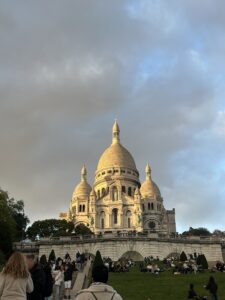
From South Pigalle, Montmartre is an obvious place to explore on foot.
Perched on a hill overlooking the city, it’s one of Paris’s most recognisable neighbourhoods, famous for its artistic history, cobbled streets and the magnificent white-domed Basilica of Sacré-Cœur, which pops out of the landscape like the white icing on a Midget Gem biscuit (retro reference!).
Once home to artists including Picasso and Toulouse-Lautrec, Montmartre still retains something of its bohemian character, although these days you’ll be sharing the streets with rather more tourists than struggling painters.
The climb up to Sacré-Cœur is worth it for the panoramic views alone. We’d been up to the top of one of the towers before, so we dodged the guys who try to thrust friendship bracelets on your wrists then charge you the earth, and just wandered around the streets, working up an appetite.
I’d also visited Sacré-Cœur with my parents and sisters as a small child – I think on a stopover on our way to Spain by rail. It also appears that my dad had been there on his 1952 trip too!
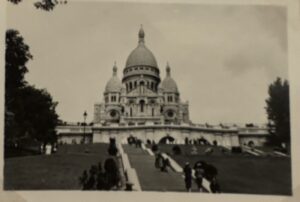
Some of Montmartre’s real charm lies in the smaller streets away from the busiest tourist spots, where you’ll find pretty houses, neighbourhood cafés and glimpses of a Paris that feels almost village-like.
Are Parisians unfriendly?
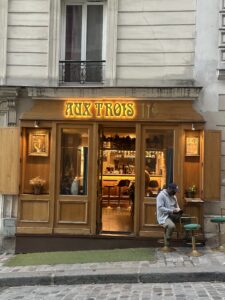
We stumbled across a quiet little community-run bar which only accepted cash called Aux Trois at Rue André Barsacq, at the end of a quiet street in the shadow of Sacré-Cœur. The super-friendly bar man, who was just opening when we arrived, told us he mixed the best St Germain Spritz and gin and tonics in the whole of Paris. We therefore had to stay and see if his claims were true!
The late afternoon was mild enough to sit at the only table outside, people watch and chat to the bar man. I don’t know where the claims that Parisians aren’t friendly have come from. We found everyone utterly charming. The people we chatted to at Aux Trois were super-friendly.
On the way back to the hotel to freshen up, we popped into GCA Café and Restaurant, again not far from our hotel, for a little refreshment. I ordered a glass of Bordeaux, but the waiter said no (with a smile), that it aws rubbish and that he would bring me something better. He did and it was…and it wasn’t more expensive either.
Some people may dismiss this slight arrogance as unfriendliness, but we never found it so. We liked it so much that we went there again for dinner one night. The waiter greeted us like old friends and told me the wine I had liked had run out, so recommended another which I didn’t like and rejected – much to his amusement.
Before going out to dinner, we received a text from the restaurant we had booked in advance, saying that they were renovating their kitchen, so they were only serving cold food that night. A bit disappointing, but it enabled us to try one of the restaurants the receptionist at our hotel had suggested.
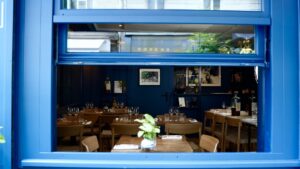
Lazu is just around the corner from ou hotel in SoPi and what a find! The food which emerges from the kitchen of chef Remi Lazuowicz is sublime. I highly recommend the razor clams, which were one of the tastiest things I have ever eaten. The chocolate mousse dessert, served with olive oil, is spooned from a large bowl, on to your plate – our server having to crack the thick crust of chocolate before doing so.
And the service was warm and delightful. Thank heavens the other place cancelled on us!
We found everyone to be superbly friendly – and the streets of the city much cleaner than I have seen before. Hardly any dog poo in sight!
From South Pigalle to the Seine: A walk through Parisian history
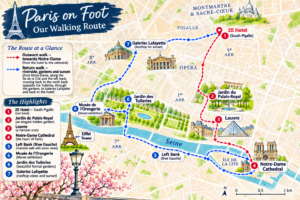
The next day, our recommended walking route took us south, towards the Seine, and enabled us to see parts of the city I wouldn’t have thought of going to.
As you make your way through Paris, the architecture is extraordinary. Much of the Paris we recognise today owes its appearance to the enormous transformation carried out under Napoleon III and Baron Haussmann in the 19th century.
Old, overcrowded streets were replaced by wide boulevards, elegant apartment buildings, public squares and parks. Those beautiful cream-coloured buildings with their wrought-iron balconies, mansard roofs and perfectly aligned façades are part of what gives Paris its distinctive character.
And walking allows you to appreciate them properly. You begin to understand that Paris isn’t just a collection of famous monuments. The city itself is the attraction.
Jardin du Palais-Royal: A little oasis in the city
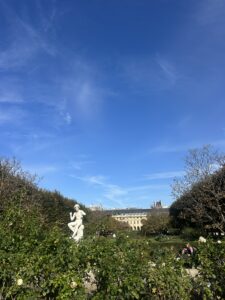
One of the most peaceful and beautiful places we discovered along the way was the immaculate Jardin du Palais-Royal. Our tour guide on our champagne tasting adventure the following day told us that not many tourists know about the gardens – and that’s probably what make it so beautiful.
Tucked behind the Palais-Royal, just a short walk from the Louvre, this elegant garden feels surprisingly peaceful, considering its central location. Surrounded by beautiful arcaded buildings, it’s a place of tree-lined paths, fountains, benches and pristine landscaping.
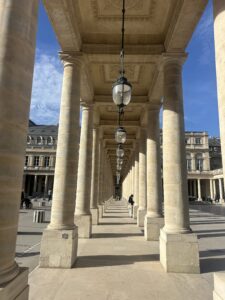
Here you’ll find Parisians pulling up green metal chairs by the fountain and reading a book while they eat their lunch.
The palace itself was originally built in the 17th century for Cardinal Richelieu and later became a royal residence. Today, the courtyard is also home to Daniel Buren’s famous black-and-white striped columns, an unexpected piece of contemporary art amid the classical architecture.
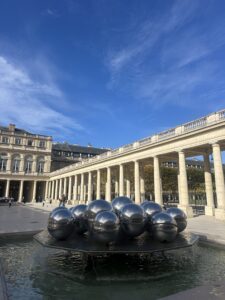
It’s exactly the sort of place you might miss if you were travelling between major attractions by taxi or Métro. And exactly why walking around Paris is so rewarding. Entry is free.
The Louvre, the Seine and the heart of Paris
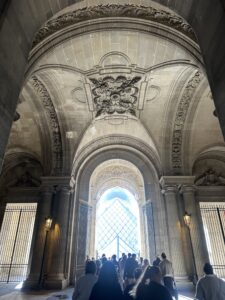
From the Palais-Royal, it’s only a short walk to the Louvre. Even if you have no intention of going inside the museum – which we have done before – the exterior is worth visiting. Book tickets in advance, though, if you want to go in.
The Louvre began life as a medieval fortress before becoming a royal palace and eventually one of the world’s most famous museums. Its magnificent historic façades and the modern glass pyramid create a striking contrast between old and new Paris.
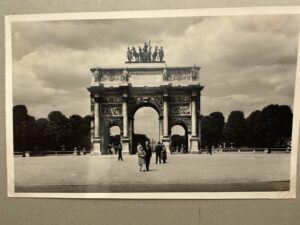
If you can make your way through the crowds of influencers, balancing on bollards to take a photo of their finger on the top of the glass pyramid, you’ll find your way to the Arc de Triomphe du Carrousel. It’s not the Arc de Triomphe (this is smaller), but it’s just as lovely. This one was built in the very early 1800s to celebrate Napoleon’s military victories. Dad had been here too!
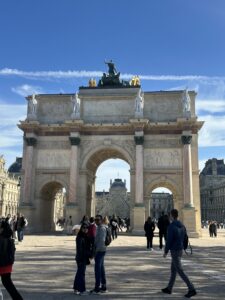
From there, we continued towards the Seine. The river is lined with historic buildings, elegant bridges and some of Paris’s most recognisable landmarks. Rather than rushing from one attraction to the next, we wandered close to the water, stopped to take photos and enjoyed the views. We had planned to take a river cruise, but that never materialised.
Don’t take photos of the posters and artwork in the little green stands that edge the river, as those guys will come after you! Eventually, our walk brought us to the place I’d most wanted to visit. Notre-Dame.
Notre-Dame: Following in my dad’s footsteps
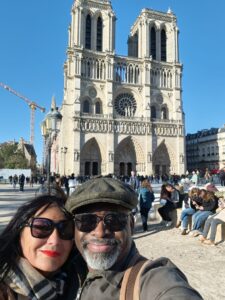
Standing on the Île de la Cité, the island at the historic heart of Paris, Notre-Dame is one of the city’s most important landmarks. Construction began in 1163 and the cathedral has witnessed centuries of French history, from royal ceremonies to revolutions and national celebrations.
Following the devastating fire in April 2019, Notre-Dame underwent a huge restoration project before reopening in December 2024. The last time we visited, it was closed. But for me, the cathedral held a much more personal significance.
On a step outside the south door on the main façade of the cathedral, my dad had stood for a photograph more than seven decades earlier. Standing there was a very emotional experience indeed.
We hadn’t booked to go inside the cathedral and the doorway where my dad posed is now behind a barrier – the main exit from the building. The only way to access was from the inside. The queues were too long and I asked if they would let me slip behind the barrier, purely for the purpose of recreating the photo. They said no. These were the only miserable Parisians I came across, to be fair!
So, I stood as close as I could, posed for photos and then got busy with ChatGPT to recreate the photo of where my dad had stood 74 years earlier, looking dapper in his suit and tie, en route back to the UK from Australia, by boat.
I had a little (big) cry while I looked at the exact place where he stood – the step itself seemingly having been replaced over the years. Scroll to the end for the result.
It was a reminder that travel isn’t always about discovering somewhere new. Sometimes it’s about creating your own memories – or recreating someone else’s.

En route to the hotel, we passed by the Musée de l’Orangerie (where Monet’s water lilies are) and the Jardin des Tulieres, where some work was going on, before heading back toward South Pigalle, via the Opera district.
I had hoped to book to go inside the Palais Garnier – as a friend said the interior was one of the most beautiful places she’d ever been – but when I tried to book it a few days in advance, it was closed. Maybe because of the rioting which had gone on nearby?
We popped briefly to the iconic department store Galleries Lafayette – to see the sunset across Paris from its rooftop (and to use the loo)! There is a magnificent observation platform and entry is free.
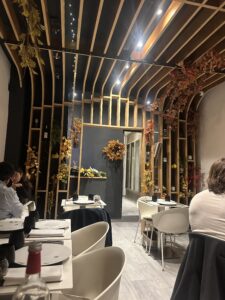
On our last evening in Paris, our restaurant cancelled on us, again without warning. As annoying as that might seem (again), it enabled us to try another of our receptionist’s recommendations –Aux 2K, directly opposite out hotel on Rue Louise-Emilie de la Tour d’Auvergne
Another sterling recommendation from the man wearing a Le Touquet-Paris-Plage sweatshirt (I didn’t get his name but I am very grateful).
This was a tiny little restaurant which was awarded a Bib Gourmand in the Michelin Guide 2024. Behind the scenes, female chefs Samantha Kagy – responsible for starters and mains – and Kimiko Kinoshita – who orchestrates the dessert menu – add a taste of Asia to the seasonal, French cuisine. I waxed lyrical about how wonderful the signature duck ravioli was and it wasn’t far to roll home to bed
Is it safe to visit Paris?
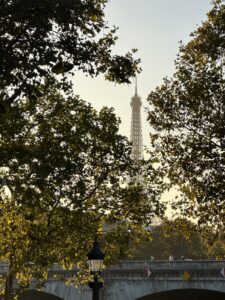
Before our visit, there had been plenty of media coverage of demonstrations and unrest in Paris. And judging by some of the comments I’d seen online, you’d have thought we were heading into a war zone rather than one of Europe’s most visited cities.
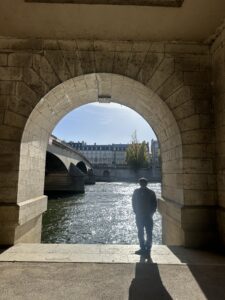
We arrived during a quieter period between reported episodes of unrest and I can only speak about our own experience. But we felt perfectly safe.
We walked extensively, both during the day and in the evening and never encountered anything that made us feel uncomfortable or threatened. Around Galeries Lafayette – a commercial centre – several shops were boarded up, in light of what had happened there the week before.
South Pigalle itself was lively, with plenty of restaurants and people out enjoying themselves, and the central areas we explored felt welcoming and relaxed.
That’s not to say visitors should ignore sensible precautions. Like any major city, Paris has its share of pickpockets, particularly around busy tourist attractions and on public transport.
And demonstrations can cause disruption, so it’s always worth checking local advice before travelling. But I certainly wouldn’t let sensational headlines put me off visiting.
We were leaving on a Saturday on which marches were planned later that day. Therefore, I purposefully brought forward our Eurostar crossing, to avoid getting caught up in any demonstrations. Roads and entrances to the Gare du Nord were closed when we made our way there, so I think I timed it just right.
Our experience was of a beautiful, vibrant and thoroughly enjoyable city.
My Tips for Exploring Paris on Foot
If you’re planning a visit, here are a few things I’d recommend.
- Choose your hotel location carefully. Staying somewhere central and well connected to the areas you want to explore makes a huge difference. South Pigalle worked particularly well for us.
- Don’t over plan. Have a rough route in mind, but allow time for detours. Some of the best discoveries happen when you turn down a street simply because it looks interesting.
- Break up your walks. Paris is full of wonderful cafés, bistros and bars. Sightseeing is infinitely more enjoyable when punctuated by an occasional kir royale.
- Look up. Some of the most beautiful architectural details are above street level. Balconies, sculptures, elaborate doorways and decorative rooftops are everywhere.
- Don’t dismiss the Métro entirely. It’s a brilliant transport system, particularly for longer journeys or when your feet have had enough. But don’t automatically assume you need it for every trip.
- Give yourself time. Paris isn’t a city to race around with a checklist. It’s a place to enjoy slowly.
As for the people who say they hate Paris: I’m afraid I still don’t understand you.
Perhaps you just need to try it on foot. And preferably with a glass of champagne waiting at the end of the walk.
I still have so much more of this city to see. Paris, I will be back.
And the photo I recreated of my dad? Here it is:
If you enjoyed reading about this French adventure, you might enjoy these:
- Paris: is the food as good as the hype?
- Champagne tasting in France
- 48 hours in Le Touquet-Paris-Plage
Found what you just read useful? Please subscribe to The Sun Lounger for more travel news, reviews and interviews.
Please follow The Sun Lounger on social media:


