
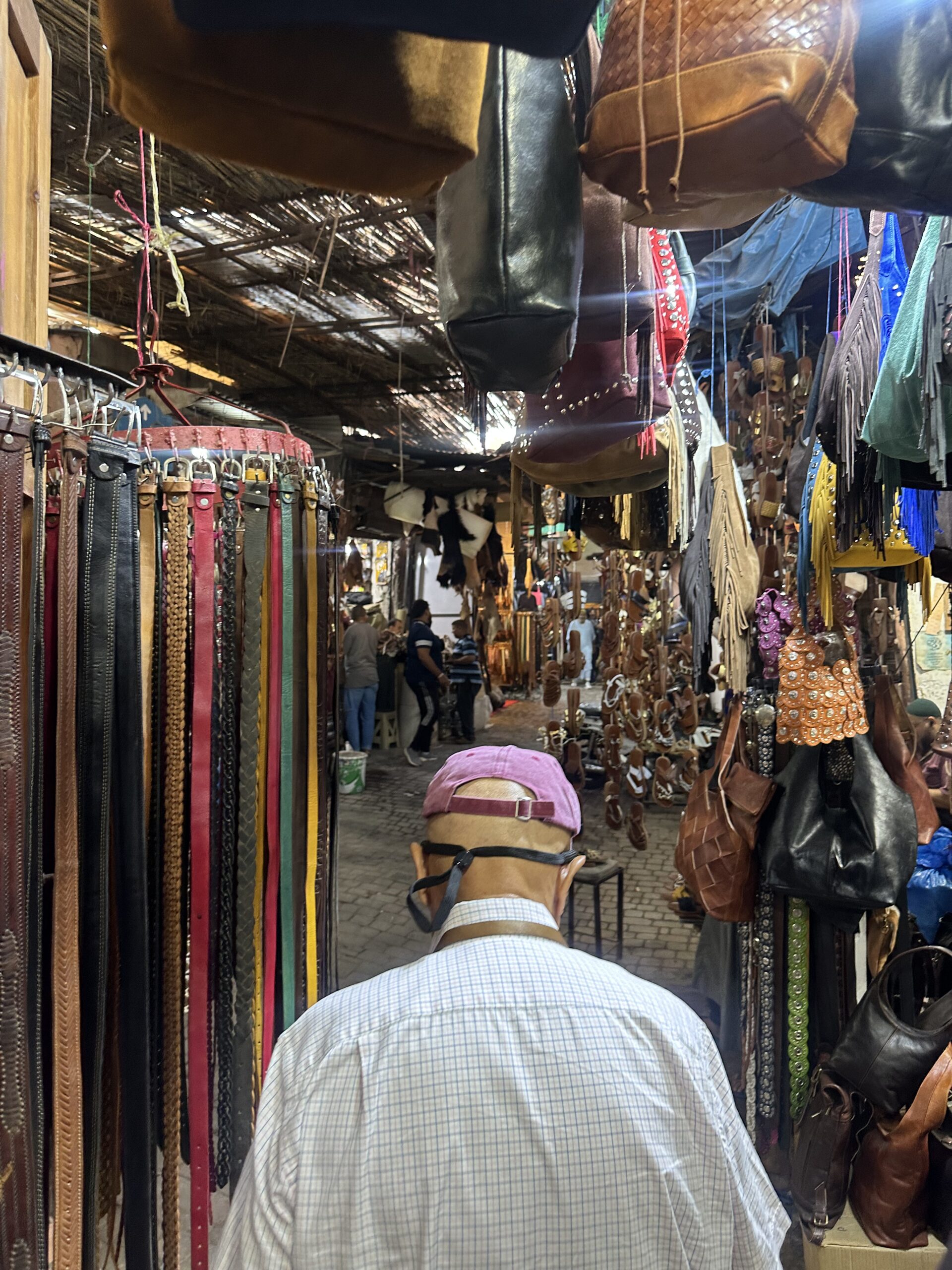
If there’s one thing I’ve learned from my trip to Marrakech, it’s this: don’t be fooled by everything you see on Instagram.
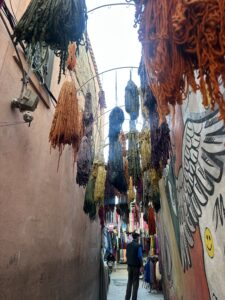
I’d seen the photographs. The impossibly glamorous rooftop restaurants, the colourful pyramids of spices, the beautiful lanterns, the pristine architecture and the winding souks. I’d been thoroughly influenced by the influencers.
I thought I knew what to expect from Marrakech. I didn’t.
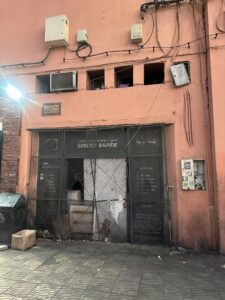
What I hadn’t considered was the dirt, the chaos, the motorbikes hurtling through narrow streets crowded with pedestrians, the persistent sellers, the poverty and the sorry sight of animals being used for the benefit of tourists, which I found genuinely upsetting.
Don’t get me wrong. Those beautiful rooftops and fabulous hotels do exist. I stayed in one of the most exquisite hotels I’ve ever visited. But the carefully curated Instagram version of Marrakech is only part of the story.
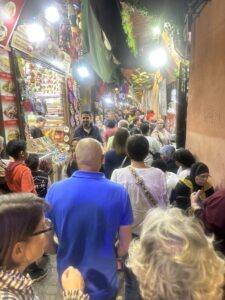
I found the medina in Marrakech quite overwhelming. Some people absolutely love that atmosphere. I discovered that I’m not one of them.
Now, this isn’t intended as a criticism of Marrakech. Travel is subjective and we don’t all have to fall in love with the same places. This is just my opinion and yours may be different. But, I shouldn’t have allowed myself to believe that almost every corner would be Instagrammable. Like every city, Marrakech has its good and bad sides.
Until a few days before our trip, I’d heard nothing but good things about Marrakech. Then a couple of friends told me they’d found it overwhelming at times, while another said she wouldn’t rush to return.
About Marrakech
Marrakech is home to just over a million people, with around 81,000 living in the medina district alone. It’s not Morocco’s capital, as some might assume – that’s Rabat – but it is one of the country’s most historically important cities.
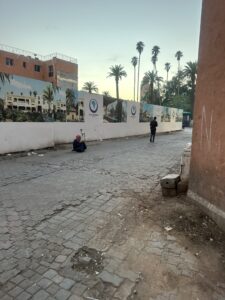
While Instagram might have you believe the medina is all beautiful lanterns, colourful spices and romantic little alleyways, the reality is that it’s also a busy, densely populated place where people live and work. It’s very much a living city, not a film set created for tourists. And that’s obviously a good thing.
There are quite a few things I wish I’d known before I packed my suitcase. So here they are: the good, the bad and the occasionally rather grubby. Some are practical, some might save you money and others might help you decide whether Marrakech is actually the right destination for you.
Get yourself a trusted driver
Our driver, Sayed, was recommended by a good friend and I’ve subsequently passed his details on to several other people (please tell him I recommended him). It was a godsend having him. We’d message him on WhatsApp and he’d be there within minutes, whatever the time of day or night – always cheery and always full of advice.
It’s also worth knowing that many restaurants and riads in the medina are hidden down narrow pedestrian lanes. Your driver may only be able to drop you some distance from the entrance. Ask to be taken as close as possible and, better still, arrange for someone from the restaurant or riad to meet you at the drop-off point.
Believe me, wandering around unfamiliar alleyways in search of a restaurant isn’t necessarily the romantic experience Instagram would have you believe.
Consider booking a local guide for the souks
I’d read countless stories about people getting hopelessly lost in the souks and I was determined that wasn’t going to be us. I booked a guide through our hotel concierge for 500 MAD (around £38/$50) for half a day. It was money very well spent.
A ‘souk’ is a traditional marketplace found throughout north Africa and the Middle East, where traders sell everything from spices, textiles and jewellery to ceramics, leather goods and local crafts, often in a maze of narrow streets and alleyways.
Our rather sedate, elderly guide, Ahmet, did take us to shops where he clearly had some sort of ‘arrangement’ with the owners, but he assured us we were under no obligation to buy anything. A well-travelled man, he’d lived most of his life in the medina and seemed to know everyone we passed, also stopping midway through our tour to pick up a prescription!
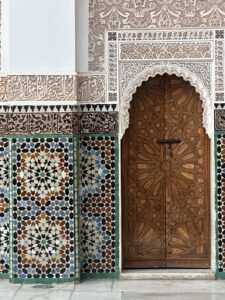
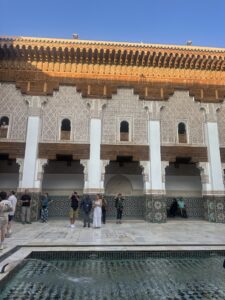
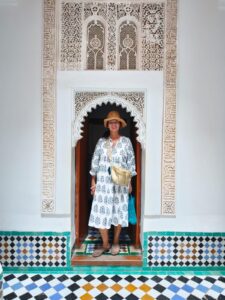
Ahmet took us to the stunning Ben Youssef Madrasa, an architectural treasure and former Islamic college in the heart of the old Medina (individual tickets 50 MAD for tourists). The magnificent building dates from the 16th century, when it was rebuilt under Sultan Abdallah al-Ghalib. It’s well worth seeing and is a complete juxtaposition to the chaos of the souks.
You can say ‘non, merci’ in the medina
Interestingly, the authorities in Marrakech have been taking steps to tackle the harassment of tourists, with police operations targeting unlicensed guides and people accused of intimidating visitors.
That doesn’t mean you won’t encounter persistent sellers. You almost certainly will. But it’s reassuring to know the authorities are aware of the problem, even though we rarely saw any police ourselves.
In January 2025, tourist police were reported to have arrested people operating as unauthorised guides around the souks, with authorities recording 749 cases involving people impersonating tourist guides.
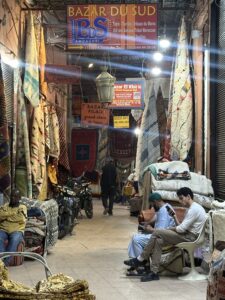
Further operations followed in May 2025, while arrests relating to the harassment or intimidation of tourists by unauthorised guides were also reported in March and July 2026. There have also been campaigns aimed at stopping traders from obstructing public streets with merchandise.
I’d strongly recommend booking a guide through your hotel rather than accepting offers from strangers in the street.
That said, I was expecting to be hassled far more than we actually were. In most cases, a simple but firm ‘non, merci’ was perfectly sufficient, which is the advice Ahmet gave us – and it worked.
Cash is king in Morocco
Many smaller shops, market stalls and street vendors prefer cash, so carry Moroccan dirhams, particularly small notes for tips and smaller purchases. Cards are widely accepted in larger hotels and restaurants, but don’t rely on being able to use them everywhere.
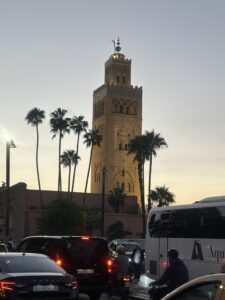
The Moroccan dirham is a restricted currency
This means it isn’t as straightforward to obtain before travelling as euros or dollars. I discovered this when I went to my local Post Office to buy some the day before travel, knowing we’d need to pay our driver in cash when he dropped us at our hotel.
You can exchange money in the arrivals hall at Marrakech airport, but there were queues when we arrived and the exchange rates weren’t particularly favourable. Fortunately, our driver also accepted Euros, as did some traders in the souks, and there was a cash machine outside our hotel.
I usually load my Post Office Travel Money Card with the local currency before going away and use it throughout my trip. Morocco was different. I couldn’t load it with dirhams, although I was able to load it with sterling and use it in restaurants.
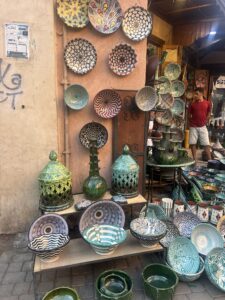
Keep 20-dirham notes handy for tips
Our guide explained that the snake charmers etc in Jemaa el-Fnaa, the main square in the medina, rely on money from tourists to make a living. If we wanted to photograph a snake in a basket or a monkey on a lead, we were told we’d be expected to pay around 20 MAD (approximately £1.50/$2) for doing so.
We didn’t want to and the sights I saw were not for me.
Book major attractions and restaurants well in advance
We missed out on visiting Jardin Majorelle because tickets had sold out. Popular attractions, including the Yves Saint Laurent Museum, are worth booking well ahead of your visit.
I was disappointed to miss it, although, to be perfectly honest, spending more time at our gorgeous hotel wasn’t exactly a hardship. Maybe my opinion of Marrakech may have been different if I had visited both.
The same applies to restaurants. Instagram makes Marrakech’s rooftop restaurants look irresistible and the best tables, particularly at sunset, can be booked up well in advance.
My advice is to decide which restaurants you particularly want to visit and make reservations before leaving the UK. You can always cancel 24 hours before, if you need.
Think very carefully before hiring a car
I’ve driven through the centre of Paris and around Rome. I’ve driven to Spain and Germany from the UK on my own and I consider myself a confident driver. Nothing could have prepared me for the traffic in Marrakech.
The fact that another vehicle was approaching seemed to be regarded as a reason to pull out in front of it. We regularly saw mopeds travelling in the wrong direction on dual carriageways and two people riding on a moped together in dense traffic, sometimes with one carrying a baby under one arm, and not a helmet in sight. Yet, it seemed to work. Sayed’s vehicle darted in and out of traffic like a needle creating a pattern in a chaotic tapestry, his hand frequently on the horn.
Amazingly, we only witnessed two accidents during our entire stay. Personally, I was happy to leave the driving to Sayed.
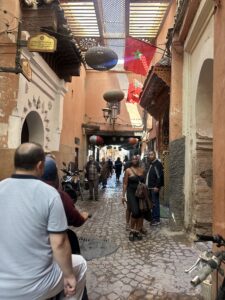
Don’t assume your phone will work in the medina
This was another reason I was pleased we’d booked a guide. I quickly realised I couldn’t rely on Google Maps. My phone only worked at the airport and hotel during the whole week, which wasn’t particularly helpful when I needed to contact our driver to collect us.
Fortunately, my partner had purchased an international roaming bolt-on from his mobile provider, so he was able to make the arrangements instead. My advice would be to check your mobile provider’s roaming arrangements before travelling, rather than assuming you’ll have coverage when you need it.
Marrakech may not be as conservative about clothing as you might expect
Before travelling, I’d been advised to cover my shoulders and knees in the medina, but I received rather different advice once we arrived.
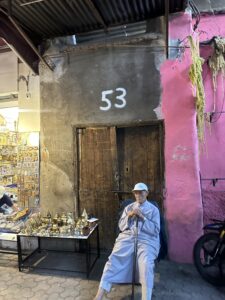
I’d packed and dressed fairly modestly, which I would do again if I went back, but when I saw several women walking around in shorts, crop tops and outfits revealing their shoulders and knees, I asked our elderly Moroccan guide (below) about it.
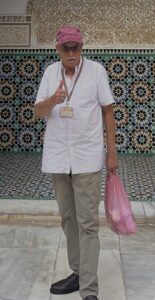
His response: “Wear what you like. We are not Iran.”
My conclusion was that visitors have more freedom in what they wear than some travel guides might suggest. However, I still think it’s sensible to dress respectfully in more traditional settings and to observe any specific dress requirements at religious sites.
One Moroccan resident told me that someone had been arrested in the medina a couple of years earlier for wearing something considered too revealing. I couldn’t verify that story, but personally, I’d rather err on the side of caution.
Ahmet also told us that Jews and Muslims have historically lived peacefully alongside one another in Marrakech and spoke warmly of the city’s tradition of religious coexistence. If only that spirit of tolerance could be replicated everywhere.
Morocco produces some great wines
This was one of my favourite discoveries. I’d never tried Moroccan wine before, but we particularly enjoyed a 2024 S de Siroua Syrah from Domaine Ouled Thaleb at our hotel. It was rather good and I think Moroccan wine deserves far more recognition, although it isn’t particularly easy to find in the UK.
On the subject of alcohol, one traveller had told me about checking into her beautiful riad and ordering an Aperol Spritz, only to discover her accommodation was completely ‘dry’. Morocco is a predominantly Muslim country and alcohol isn’t available everywhere, although many licensed hotels and restaurants serve it.
Personally, we didn’t visit anywhere that didn’t serve alcohol and I found Marrakech’s tourist hospitality scene more relaxed in that respect than I’d expected. Still, if a sunset cocktail is an essential part of your holiday, it’s worth checking before booking your accommodation.
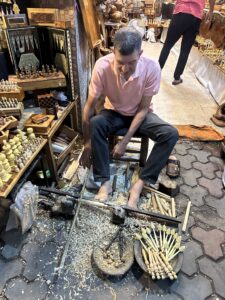
What exactly is the medina?
It’s actually the original, walled city of Marrakech, founded almost 1,000 years ago, between 1070 and 1072. Its distinctive reddish walls date back to the 12th century and the entire historic area was designated a UNESCO World Heritage Site in 1985.
Marrakech is known as the Red City because its ancient medina walls were built using local iron-rich clay, giving them their distinctive faded terracotta colour, while their thick earthen construction helps keep the heat at bay. Ahmet told us that red was chosen over white, to repel the scorching heat.
It’s a sprawling maze of narrow streets, alleyways, souks, homes, mosques and historic buildings. And while tourists might think of the medina primarily as a place to shop, sightsee and take photographs, it’s important to remember that this is also where people live, work and go about their everyday lives. It isn’t a purpose-built tourist attraction, but a living, breathing city that’s been evolving for almost a millennium.
What’s the medina in Marrakech like?
I arrived expecting to love the medina’s energy, colour and atmosphere. I didn’t. My children, however, loved it and said they had a completely different experience to me.
Our first excursion was after dark, when we headed to La Pergola restaurant, situated on the terraces of Riad Monceau, close to Jemaa el-Fnaa square. The restaurant was extremely well hidden and we struggled to find it.
I confess to being a bit of a wimp. I clung to my partner’s hand as we negotiated the crowded streets, unfamiliar alleyways and general chaos. Nothing frightening happened. It was simply so unlike anywhere we’d been before that it took some getting used to. I didn’t feel particularly unsafe, but neither did I feel entirely comfortable.
Some travellers absolutely love that sensory overload. Others don’t. And I discovered that I fall into the latter category.
Despite thinking we were going to be on a rooftop, listening to jazz, we weren’t exactly. It was tightly packed and the jazz band was on the ground floor, with TVs around the terraces, showing them. There were no views from where we were sitting and it wasn’t the rooftop experience I was expecting. That said, the service was good and the music really interesting.
There are a myriad of good restaurants in and around the medina, such as El Fenn (arguably the coolest rooftop of all) and La Trattoria (book way in advance and get a table by the pool).
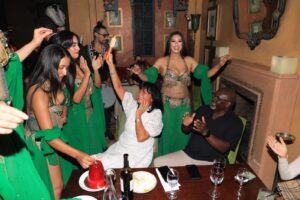
We really enjoyed the show at Palais Jad Mahal (above) which, I felt, overshadowed the food. Towards the end of the show (think fire breathers and trapeze artists), the performances moved from the central stage to the back of the restaurant, where there appeared to be a more exclusive area. That signalled it was time to go home.
We asked for a table near the stage, as it was my birthday. We didn’t get that, although we did get belly dancers and flares, plus a candle to blow out on a faux birthday cake at our table. It was very touristy but very memorable and worth visiting. It was a loud and fun night.
There’s more to Marrakech than the medina
We stayed in the Palmeraie area, around 30 minutes from the old town, and it showed us a completely different side of Marrakech.
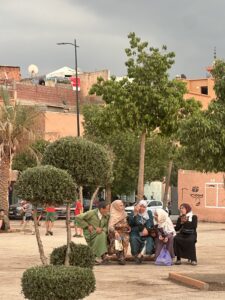
On the journey to our hotel, we passed empty rivers full of plastic bottles, butcher’s shops with meat hanging in the sun and makeshift homes constructed from cardboard and breeze blocks, as well as homes of the wealthy, golf course complexes and people going about their daily lives.
The contrast with our accommodation couldn’t have been greater. I felt tremendously privileged to be staying among tranquil gardens, waking each morning to birdsong, the sound of fountains and beauty everywhere I looked.
We were told that Tom Cruise, Mick Jagger and even the Prince of Poland (I wasn’t aware there was one) owned palaces in the Palmeraie. I couldn’t substantiate any of these claims through my own research, although we certainly drove past palace after palace, hidden behind high walls and grand gates, some with security guards stationed around their perimeters.
Haggling is part of the shopping experience
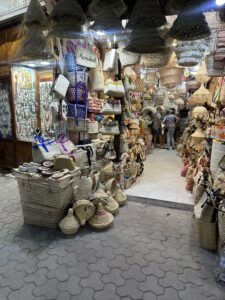
I discovered that I love to haggle and I was happy when one vendor told me to offer whatever I liked and assured me that neither he nor his fellow businessmen would be offended. Don’t feel obliged to accept the first price quoted in the souks.
My advice would be to start at around 50% of the asking price and know when to walk away. Negotiate politely and respectfully, with good humour, and decide beforehand what you’re prepared to pay. And remember, what might seem like a small amount of money to you could mean considerably more to the seller.
I’d been told that walking away was a sure-fire way to get a better deal, with vendors supposedly chasing after you to accept your ridiculously low offer. Well, I tried it a couple of times and nobody came running after me. Clearly, my bargaining skills weren’t quite as irresistible as I’d hoped.
That said, I did come home with a beautiful piece of artwork, now proudly hanging on my wall in the UK. Its original asking price was 1,650 MAD (around £125/$167) but I managed to secure it for 600 MAD (around £45/$61). Not bad for a morning’s haggling, even if nobody chased me down the street.
Is Marrakech safe for tourists?
I never felt I was in any danger. I can’t honestly say I felt entirely ‘comfortable’ wandering around the medina at night, but that is purely due to the fact that it’s chaotic, crowded and sometimes intimidating, particularly when you’re unfamiliar with the maze of narrow streets and alleyways.
According to the UK Foreign Office, petty crime is relatively common in Morocco’s tourist areas, particularly the medinas. Pickpocketing, bag-snatching, scams and harassment from unofficial guides are among the things visitors are warned about.
That doesn’t mean Marrakech is inherently dangerous and thousands of tourists – including us – enjoy visiting without experiencing any problems.
But I think it’s sensible to be aware of the potential issues rather than arriving with an entirely rose-tinted view, just as you would when visiting other busy tourist cities such as Barcelona, Paris, Rome or London, each of which have their own issues.
Keep your valuables secure, avoid wandering down deserted alleyways after dark, book a reputable guide if you’re unfamiliar with the medina and arrange transport to and from restaurants in advance.
And remember, feeling overwhelmed by a place isn’t necessarily the same thing as being unsafe. I certainly felt completely safe in our hotel every night.
Be mindful of the contrast between luxury tourism and everyday life
One of the most sobering moments of my trip was seeing a young boy sleeping on cardboard as we waited by the side of a busy road for our transfer back to our five star hotel. The contrast was impossible to ignore and still plays on my mind.
That said, I’ve seen considerably more homeless people on the streets of London than I did in Marrakech.
I was also distressed by the sight of visibly lame, poorly conditioned horses pulling tourists through extremely heavy traffic and monkeys on leads being made to perform for photographs.
These experiences were a stark contrast to the glossy Marrakech I’d seen on social media.
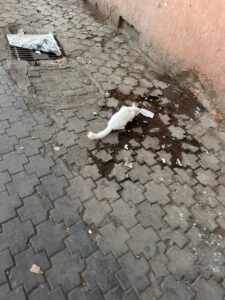
Of course, animal welfare concerns aren’t unique to Morocco. New York, for example, has also faced considerable controversy over its horse-drawn carriages.
I appreciate that when people are struggling to make a living, animal welfare may not be their first priority. But as tourists, we have a choice about what we support and where we spend our money. I’d encourage visitors to think twice before paying for animal-based attractions, while recognising the economic pressures facing local communities.
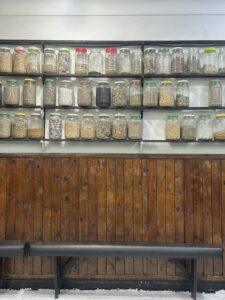
French influence in Marrakech
Morocco was under French colonial rule from 1912 until gaining independence in 1956. Although officially known as a French Protectorate, France exercised considerable control over the country’s government, administration and development.
The French left a lasting mark on Marrakech, particularly through the creation of Guéliz, the modern district built outside the ancient Medina walls. Unlike the Medina’s maze of narrow alleyways, Guéliz was designed with wide boulevards, European-style buildings, cafés and shops. Then there’s the wine, of course.
The French largely preserved the old Medina’s traditional architecture, although their approach also reinforced the separation between Moroccan residents and European settlers. French influence can still be seen in the city’s architecture, cafés, restaurants and, of course, language.
Although Arabic and Amazigh are Morocco’s official languages, French remains widely spoken, particularly in business, hospitality and tourism. So, if your school French is better than your Arabic, you might find it comes in rather handy.
Just don’t assume everyone speaks French – or English, for that matter.
Where to stay in Marrakech
We almost booked a riad in the medina, simply because they looked so beautiful. But I eventually decided that the medina might be a little overwhelming for my partner, so I chose the Palmeraie instead. As it turned out, it was probably more the other way around.
We made three trips into the medina during our week in Marrakech and some might argue that by staying outside the old town, in our hotel, we could have been in any hot country. I don’t agree.
While adventure companies messaged me, trying to entice me to visit traditional hammams, take rides in hot air balloons, visit waterfalls, go quad biking, trek through the mountains, visit the desert and dine on traditional cushions by the side of a rushing river, I was quite at peace laying in the sun, watching ‘my’ pomegranates ripen and dipping in and out of the pool.
Our hotel was an absolute oasis and staying there made me realise something about myself: while I love traipsing in and out of cities, the constant chaos and intensity aren’t necessarily for me any more, or if, indeed, they ever were.
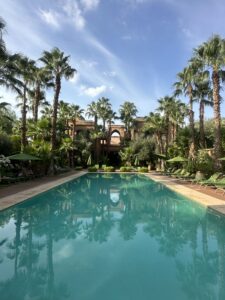
I personally wouldn’t rush back to Marrakech itself, but I would happily return just to stay at Tigmiza again. Everything about it was beyond perfect. We were pushing the boat out, staying there to celebrate my significant birthday.
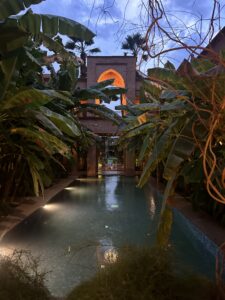
We spent seven night, staying in a simply stunning one-bedroom villa (below) with a private pool. There were pomegranates, figs and rosemary growing its lush garden. We felt extremely lucky to be staying so in such a gorgeous place (€360 per night in October).
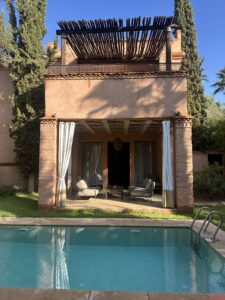
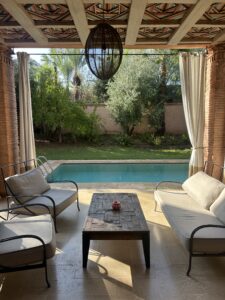
Every now and then, you come across somewhere that gets absolutely everything right. For me, Tigmiza is one of those places.
Behind its relatively small and unassuming entrance lies a simply breathtakingly, beautiful hotel, with three communal pools set among tropical gardens, fountains and water features running throughout.
It’s a tranquil oasis, a world away from the chaos of the medina. The Moorish-inspired architecture and interiors are awesome, but what helped make the hotel so special were its staff members.
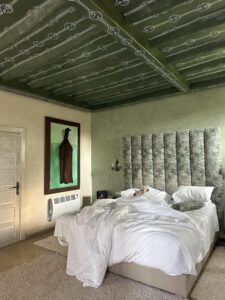
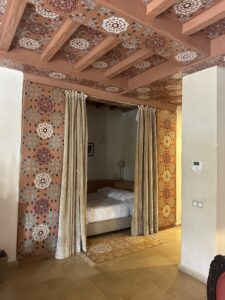
They were among the happiest, kindest and most genuinely welcoming people I’ve encountered. Nothing was ever too much trouble. You asked for something and it appeared, seemingly effortlessly and always with a smile.
From the fresh rose petals arranged on our bed in a different design every evening to dancing with members of the staff on our final night, it was the little touches – and the people themselves – that helped male our stay so memorable. Book the Moroccan night if you can. The experience is delightful, as is the food.
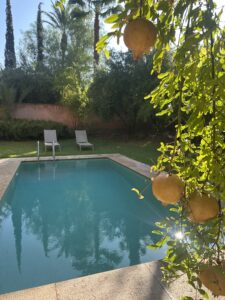
I read that it was built and is run as a family kasbah, designed to feel like a grand, welcoming home, rather than a traditional corporate hotel – and that is exactly what it feels like, albeit a rather luxurious family home! It is one of those rare hotels I genuinely struggled to find fault with.
So, would I recommend Marrakech?
If there’s one thing I’d like people to take away from this article, it’s that social media doesn’t tell the whole story. Those glorious rooftop sunsets, colourful souks and luxurious riads are real, but they’re only part of the picture. Through my social media channels, I always try to deliver a realistic view.
Research your destination beyond influencer content. Read different opinions, talk to people who’ve actually visited and don’t assume that what looks beautiful on Instagram will necessarily be your idea of paradise. Something I, rather stupidly, hadn’t done.
And remember, you don’t have to love everywhere you visit. You can appreciate the history, culture and beauty of a destination without wanting to return.
I’d wanted to visit Marrakech for years and, while my experience was mixed, I’m glad I went.
I’m happy I experienced the medina, but I doubt I’ll ever feel the need to return to it.
Tigmiza, on the other hand? I’d go back tomorrow.
You can read three very different reviews of Moroccan holidays here:
https://thesunlounger.co.uk/travel-insights-and-tips-navigating-moroccos-unique-customs/
https://thesunlounger.co.uk/yoga-travel-and-self-care-a-one-woman-moroccan-adventure/
https://thesunlounger.co.uk/the-marrakesh-express-a-two-week-overland-trip-to-morocco/
Please follow The Sun Lounger on social media:


