
In a word: yes.
The end.
Actually, I’ve taken lots of photos…so I’ll elaborate.
We went to Paris in early spring, my partner never having been and me not having been for a couple of decades. In fact, I last visited when I took a group of press for lunch in Paris, travelling on the Eurostar, to launch a range of sex toys for a client. Oh, the looks I got when my bag of props went through the French security scanner.
Mention you’re going to Paris and the words ‘dirty’ and ‘rude’ often tumble out of people’s mouths. Others wax lyrical about the French capital. Everyone has an opinion and everyone needs to go at least once in their lives, right? So, we went, as a birthday surprise for my partner (although my sister did sort of let it slip, but we will ignore that bit).
I loved it. Paris was everything I had dreamed of and more than I had remembered. One of the best things about the city was, without doubt, the food.
My food hero, Rick Stein, went on a road trip around France to find out if the food was still all it’s cracked up to be. We did something similar, but around Parisian bistros instead.
First of all, the question: are Parisians rude? On my frequent travels to France, I have yet to conclude that this is anything more than a myth. I have experienced far ruder people in London and elsewhere in the UK. We found everyone everywhere warm, welcoming and chatty. We had one miserable Uber driver, but hasn’t everyone?

So where are the best places to eat in Paris? Let me tell you about our experiences – from neighbourhood bistros to one magnificent gilded shrine of gastronomy. By the way, I have no idea what the difference is between a ‘bistro’ and a ‘bistrot’, if indeed there is one.
Apparently, the Dictionnaire de l’Académie française dates the word from the 19th century term, bistro, meaning ‘innkeeper’, and suggests that it may be linked to the word ‘bistraud’, meaning ‘little servant’, or to ‘bistouille’, meaning ‘cheap booze’.
‘Bistro’ may also be a mispronunciation of a Russian word that meant ‘hurry’; something that Russian soldiers would apparently shout at cafe and restaurant owners during their occupation.
Whichever is correct and whatever it means, here are my favourites out of many wonderful Parisian bistro/restaurants (and a few howlers, I am sure):

I read about this neighbourhood eatery in the New York Times book ’36 Hours Europe‘, which I generally refer to for inspiration when I book a European short break. It said: “If you go to only one Paris bistro in your life, go to Paul Bert. Its owner, Bertrand Auboyneau, will warmly welcome you in this former horse meat butcher shop, with its zinc-topped bar, wooden tables and red, yellow and blue tiled floors. The food is traditional, perfectly-prepared, seasonal French bistro cuisine delivered with exceptional service.”
It also stated that is the favourite Paris bistro of Jean-Claude Ribaut, a food critic for Le Monde. Seemed like a good recommendation, so I booked in advance (dreadful website, but why worry about the internet when your food is so good and it’s always heaving, I guess).
I couldn’t find how to book online and was dubious about my ability to book a table in French over the phone, so asked a French friend of mine to call and reserve for me. I’d read online that they’ve stopped answering the phone as it rings non-stop with people who’ve probably read the recommendation in 36 Hours Europe and want to get their slice of Paris on a plate, so I was concerned that we might not get a table.
I’m not sure why I thought a native French speaker would have a better chance of getting through than I did, but it worked and our table was reserved. No stress at all. Our table turned out to be a lovely one right by the window, so we could look out on the dark, damp Parisian evening, as we felt smugly warm, drinking great red wine from the owner’s cellar. The waiter complimented me on my choice of cuvee, btw, which was pure fluke.

The restaurant promises ‘cuisine familiale’ (family cooking or kitchen) and the food is, without doubt, prepared with love. You’ll find all the textbook French bistro favourites on the menu, such as tartare de bœuf (€26), poularde farcie (€29), fillet de bœuf au poivre (€39) and côte de bœuf (€85 – for two people).
As a result of it getting such a strong recommendation in the book, there was more of a concentration of Americans here than anywhere else we ate, some of whom were particularly loud and had the owner’s eyeballs rolling rather a lot.
Staff were lovely, the ambiance was terrific (once the shouty people had left) and it felt like a quintessential French bistro in the gastronomic haven of the 11th arrondissement. Parisians kept piling through the door well after 10pm, which felt like a good sign. The book was right.
The cuisine was delightful. Nothing fancy about its presentation, just good, honest, well-cooked delicious food, made with passion for the ingredients.

One of my marks of a good bistro are the crepes Suzette. Sometimes they can be too sweet, sometimes too orangey. This one was delicious.

If I had to choose just one French bistro to go to, it would be Les Temps des Cerises. We stayed on the edge of Le Marais and this pretty corner house is between Place de la Bastille and there.
One of the oldest restaurants in Paris (it’s been there since 1830), I found this place just perfect, with probably the best duck I have ever tasted. Back in the 19th century, Les Temps was in the countryside, in the middle of a cherry orchard (hence the name).
Run by a team of young, cool and passionate ‘bistronomy enthusiasts’, they could so easily turn this into a trendy eatery, but it retains its 1930s decor of mosaic exterior, zinc counter and wooden interior.

Apparently, the name of the bistro was chosen in 1968 and refers to a song by Jean-Baptiste Clément. Although I thought it was about a cherry orchard, the ‘Time of Cherries’ is apparently a metaphor about what post-revolution Paris would be like according to the Paris Commune – a French revolutionary government.
The song is thought to be dedicated to a nurse who fought in the Semaine Sanglante (‘bloody week’), a week-long battle in Paris from in 1871, during which the French army recaptured the city from the Paris Commune.

History lesson aside, I had Tuna tartare, avocado cream with herbs (€14), magret de canard (which I can no longer see on the menu) and mille-feuille with red fruits (€11). As far as French bistro go, this was reasonably priced too.
Please go…and then message me and tell me you loved it too.

Our quest for the best Marais bistro continued with Au Bascou, which was chosen by my bloke.
I was slightly worried about this one, as it’s Basque cuisine, and when I’m in Paris, I like to eat Parisian food. The same way that I wouldn’t go to Italy and have sushi, for example. I don’t like to admit it, but I was wrong.
Behind the scenes in this quite plain and simple little eatery, chef Renaud Marcille serves up the most delectable flavours. The menu constantly changes, to reflect what’s in season and the great majority of ingredients come from small producers and master artisans.

I had the fricassee of chiperons (baby squid) to start with (€12), which was super-soft and delicious. I also loved that the warm bread came in a little cloth pocket too.
The stand-out dish on the menu (my partner had it and I had MASSIVE food envy) was the supreme de poularde. Neither of us had ever tasted chicken like it. Soft isn’t the right word, as it was beyond that. It was almost mousse-like in its texture, but not. It was unbelievable. We didn’t get any photos of it as we were too busy scoffing!

I had to Google what a ‘poularde’ is and apparently it’s a culinary term for a chicken that is at least 120 days old at the time of slaughter and fattened with a rich diet that delays egg production.

We didn’t look at the price at time of ordering the poularde, but one would expect it to be nothing short of wonderful at €50 a portion. We were a little taken aback and were glad we didn’t see the price before, otherwise we probably wouldn’t have ordered it. My goodness, it was so good.
As well as Basque-inspired dishes, like cod with chorizo and seasonal vegetables (€23), you’ll find classics like saucisson Ardechois (€8), scallops with endive and orange (€26) and ravioli with ceps and black truffle (€19).

Saving the don dada of all French eateries until last, I’d seen the iconic ‘blue train’ all over Instagram and a friend had tried to get a reservation, but failed, when she was in Paris.
I was jubilant to find there was some availability during our stay, but only at 11.15am on the Sunday, 90 minutes before we had to be at Gare du Nord to get our train back to London. But I wasn’t going to miss this experience for anything.

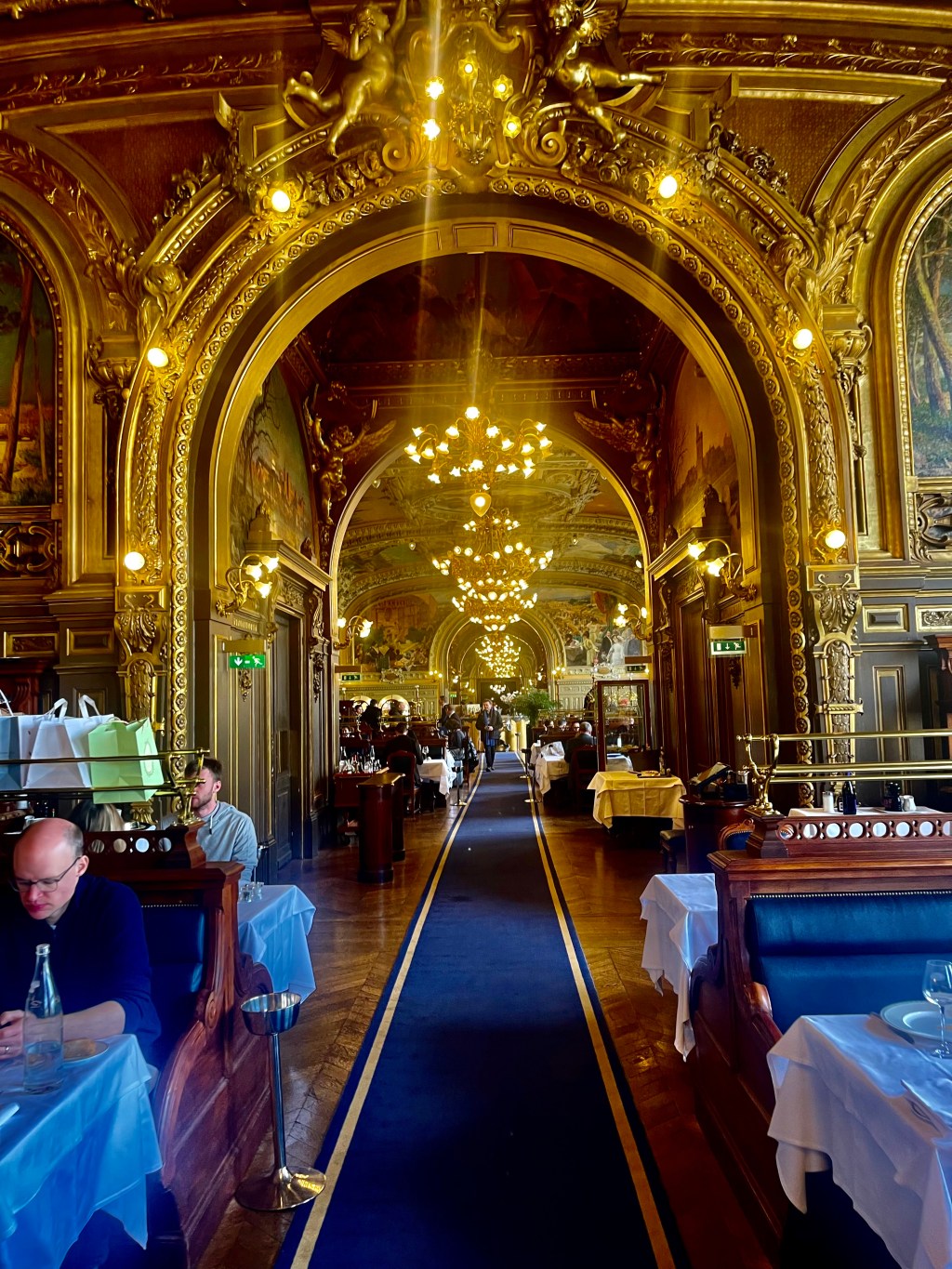
I still can’t wrap my head around the fact that this iconic restaurant is upstairs at Gare de Lyon – one of the nine mainline train stations in Paris – and there’s something strange and unexpected about going upstairs from the concourse and into this sumptuous, most decadent of gilded interiors, formerly the station buffet.
In 1963, the buffet became ‘Le Train Bleu’ as a tribute to the Paris-Vintimille line dating from 1868, the legendary train that served towns in the French Riviera along the Mediterranean coast.
We were the first there and that was fine, as it meant I could wander around with my mouth open, taking photos of the interior, before filling it with the most exquisite of morsels.

Time was tight, so I decided to go for two courses: main and dessert, as there wouldn’t be time for three. You can also get a takeaway here, which seems bonkers, but amazing. Imagine popping to this shrine of decadence to get something to eat at your desk. Glorious!

I saw a shiny, prestige trolley being rolled about, looking very much respected and revered, and I knew that I wanted to eat whatever was inside (just hoping it wasn’t stinky cheese, which I want to love but my stomach won’t let me).
One look at the menu and I knew it had to be the house speciality – the roast leg of lamb carved at the table from the trolley, simply served with acclaimed chef Michel Rostang’s potato gratin dauphinois (€42).
Et voila, with such pomp and circumstance, the lamb was carved and laid before me, with delicate and deeply-flavoured jus. Good lord, it was exquisite.
Despite being a very fancy establishment, the super-attentive service was confident, but warm and friendly. For dessert, I had to round off the weekend with another portion of crepes Suzette, flambéed with Grand Marnier (€18), which was done at the table again. I can help by ‘ooooh’ when I see the flames.

The only bad thing about this meal is that we didn’t have long enough to really savour it and enjoy three courses, but that means we need to go back and do it again.

We stayed in a teeny studio apartment on the 7th floor of a classic Paris apartment block in the 11th arrondissement, booked via Airbnb. It was billed as being in Le Marais, when in fact it was on the far edges, but that was fine. It had a lovely view over the rooftops of Paris and had little bars, nice restaurants and a boulangerie all within a few minutes. It cost £600 for 4 nights.

I did cross Paris a few weeks later, when on my way home from Brittany, and was very pleased that wasn’t my first impression of this precious city. It was during the refuse collection strike and the beautiful streets were piled high with rubbish and bags had been ripped open, and the rats were having a free for all.
I must go again, as I also don’t want that to be my last impression either.


 The Sun Lounger
Leave a comment